




Incode takes first place in document forgery and face liveness detection at IJCB 2026
Incode has won across two independent, blind-evaluated presentation attack detection benchmarks: both tracks of the Third Competition on Document Forgery Detection on ID-Cards and Passports (PAD-ID Card 2026), and the video category of LivDet-Face 2026, an independent face liveness detection competition presented at the International Joint Conference on Biometrics (IJCB) in Rome.
For document forgery, this is the second consecutive year Incode has won Track 2, and the first year Incode has entered Track 1, which it also won. Incode is also the only team to beat the Track 2 baseline in all three years the competition has run, including 2025 and 2024.
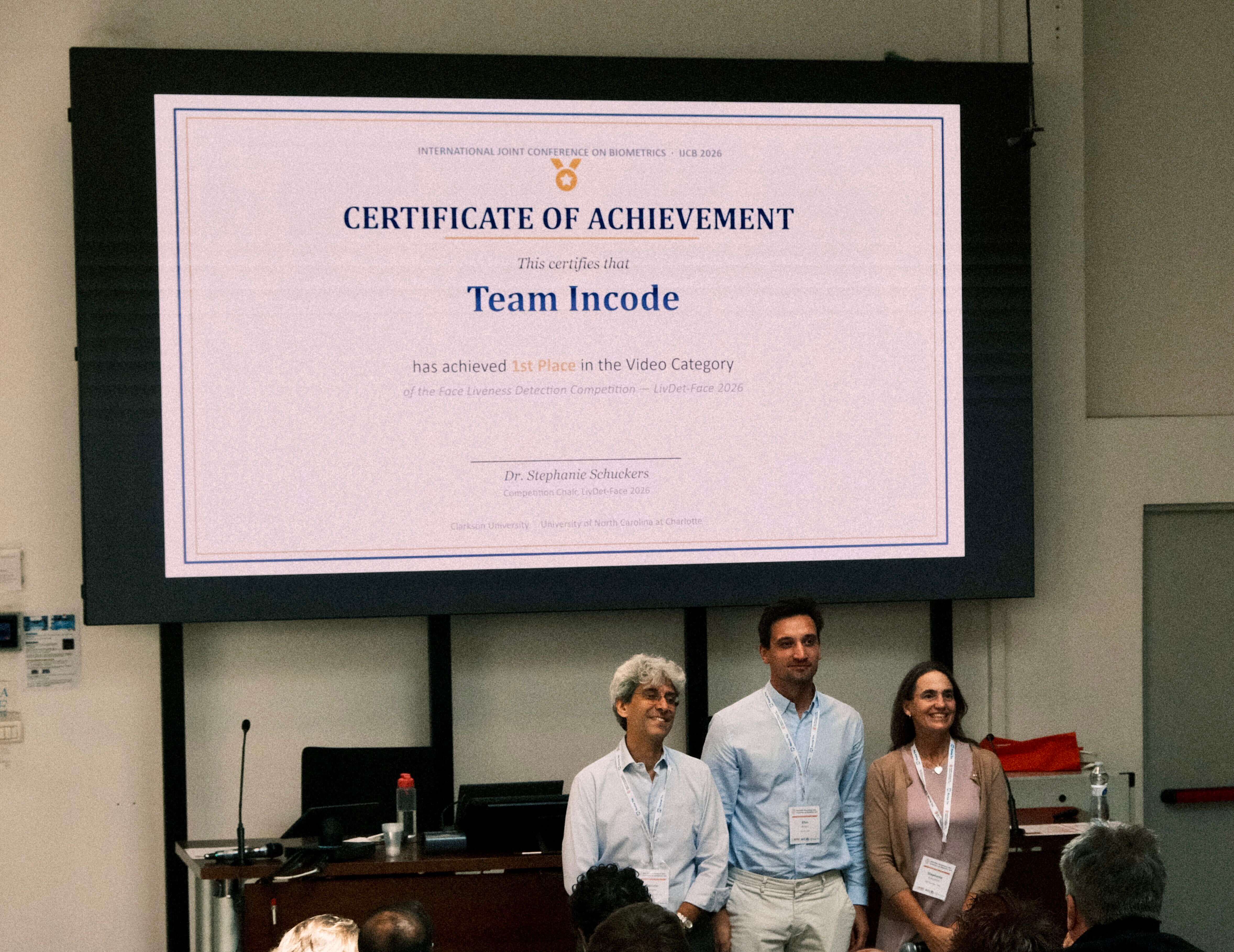
For face liveness, this is the first year Incode has entered LivDet-Face, and its video submission won outright with an average classification error rate of 4.74%, ahead of the next-closest of eleven competing teams at 8.94%.
What the PAD-ID Card competition measures
Presentation attack detection (PAD) determines whether an ID card or passport shown to a system is genuine or an attempt at fraud, whether that’s a printed photo, a screen replay, or an altered document. Fraudsters use manipulated documents to impersonate someone else and unlock benefits they aren’t entitled to, from opening a bank account to passing a background check. Independent benchmarks like this one exist because PAD claims are otherwise hard to compare: every vendor can report strong numbers against its own test set.
Track 1 and Track 2 of the PAD-ID Card competition measure the effectiveness of related processes under differing conditions:
- Track 1 evaluated a synthetic-data-based PAD system under controlled but varied conditions, with every team training on the same shared dataset. This measures how well a model performs when the training data is fixed and the model’s own design has to do the work.
- Track 2 measures whether a model’s performance holds up once real capture conditions, real datasets, and real fraud attempts replace a controlled, shared benchmark. The track is open to all, but favors industrial partners with access to real-world data, since teams train on their own proprietary, homemade, or open-access datasets instead of a shared synthetic set, and are not required to reuse their Track 1 model.
Winning both tracks demonstrates two different strengths, not one model doing double duty. Track 1 isolates the technology itself: with every team training on the same data, the win comes down to whose architecture handles it better. Track 2 tests generalization: Incode's production model had no control over capture conditions, document type distribution, or attack methods, yet still scored best on a blind evaluation. In production, Incode controls all three, which is exactly why the underlying technology is built to generalize even without that control.
Incode’s document forgery results
In Track 1, Incode’s model returned an equal error rate (EER) of 8.42%, ahead of the next-closest team at 10.68% and well below the field median, which sat near 24% with several teams above 40%. AV_Rank, the composite metric the competition uses to determine its winner, also placed Incode first in Track 1, at 27.82%.
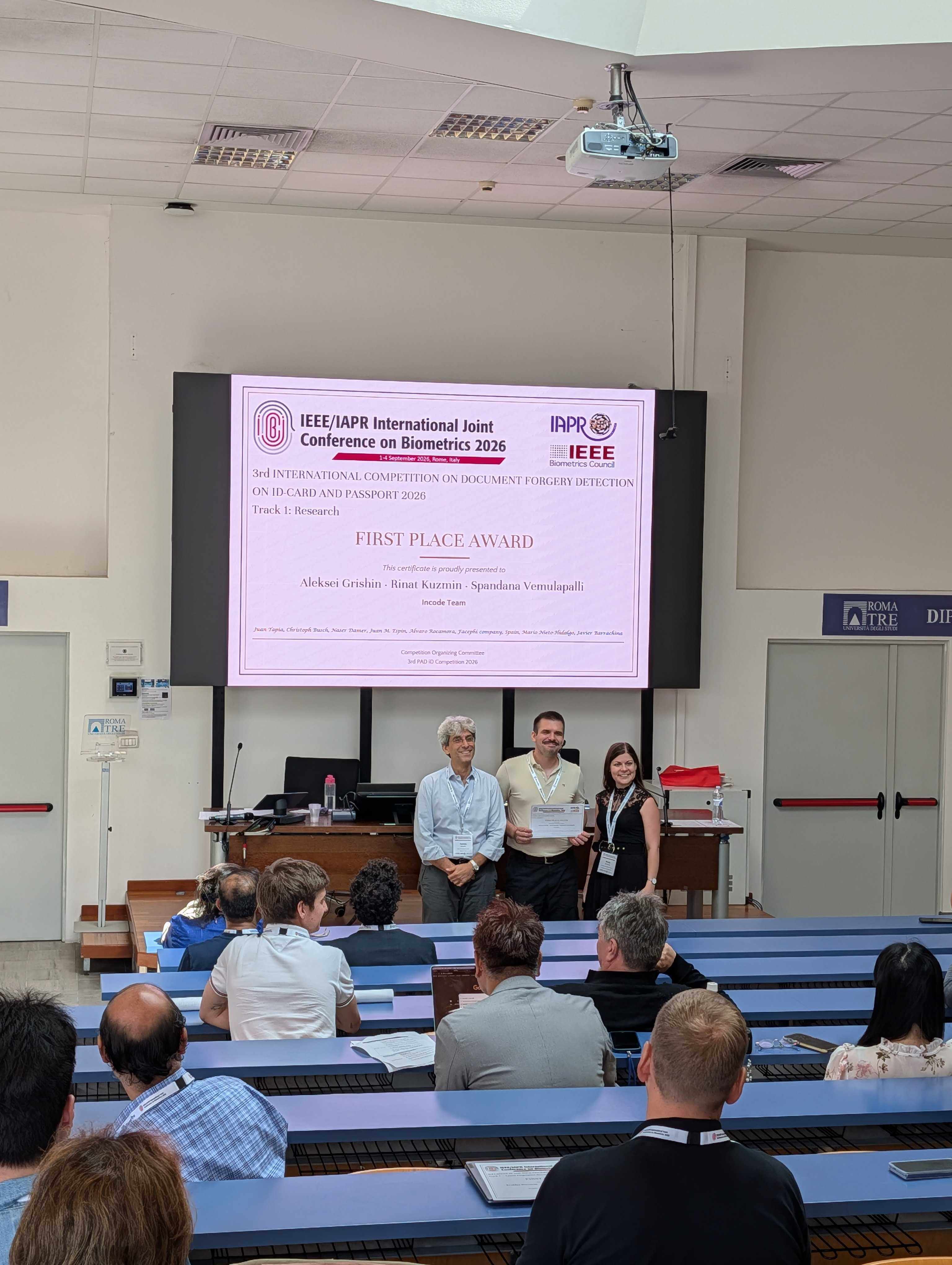
In Track 2, Incode placed first again, with an AV_Rank of 68.71% across thresholds, outperforming all established baselines. Incode is the only team to win both tracks in the competition’s three-year history.
Why the spread matters more than the score
Every team in Track 1 trained on identical data. The spread in results, from single digits to more than 40% EER, says something the raw ranking alone doesn’t: given the same training data, architecture and generalization discipline decide the outcome. Data access isn't the deciding factor.
What LivDet-Face measures
LivDet-Face is an independent face liveness detection competition now in its third edition, co-organized by Clarkson University and the University of North Carolina at Charlotte and run in conjunction with IJCB. Eleven teams from multiple countries submitted a combined 19 image algorithms, 11 video algorithms, and one full biometric system for independent testing against ten presentation attack types, including a newly introduced makeup skin-tone 3D mask. All evaluation data was sequestered, so no team could train or tune against the images and videos that ultimately scored them.
Incode’s face liveness results
Incode’s video submission won the video category with an average classification error rate (ACER) of 4.74%, ahead of the next-closest of eleven competing teams at 8.94%. The toughest attack categories in the competition, high-quality 3D masks and skin-tone masks with hair, are exactly the kind of presentation most likely to fool a system relying on single-frame cues alone.
Why winning the video category matters
Video-based liveness checks whether that same live person stays present and consistent across an entire video. This capability has become crucial as deepfakes become more nuanced, enabling fraudsters to appear, move, and act completely naturally, even across several frames.
Incode’s video entry pairs a production-grade face detector, tuned to favor sharp, frontal frames, with a temporal model built on an internal foundation-model backbone purpose-built for detecting physical spoofing attempts. That same principle, detecting an imposter across multiple frames rather than a single image, is what powers Deepsight, Incode’s deepfake and injection-attack detection system.
Third-party results that count
The IJCB win extends a strong run of independent validation for Incode this year. Deepsight, Incode’s deepfake detection system, was benchmarked by Purdue University as best-in-class among commercial tools, and Incode separately achieved FedRAMP Ready status, opening the door to U.S. federal agencies. The pattern holds across each of these: independent evaluators keep confirming what Incode’s customers already see in production.
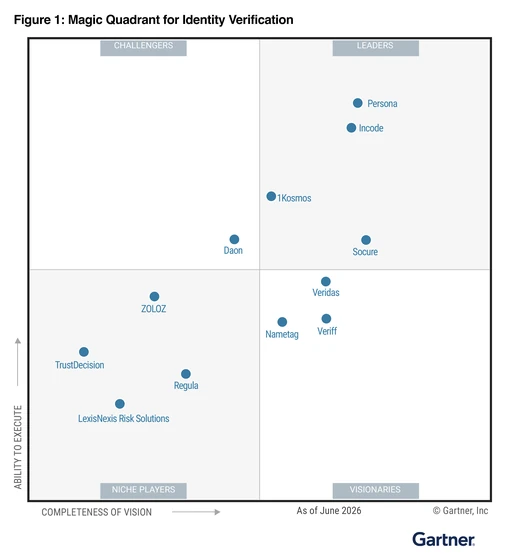
Incode was named a Leader in the 2026 Gartner® Magic Quadrant™ for Identity Verification. Download the report.
Ready to see Incode in action? Request a demo today.