



Introducing Incode On-Device Age Estimation, the First On-Device Age Assurance Solution With Enterprise-Class Privacy, Accuracy, and Security
Today, Incode launched On-Device Age Estimation, the only age assurance solution that delivers enterprise-ready privacy, accuracy, and security simultaneously, with no biometrics leaving the end user’s device.
When given a choice, eight out of 10 consumers choose facial age estimation over other age assurance methods. With Incode On-Device Age Estimation, platforms can offer users their preferred method of age assurance while upholding best-in-class, enterprise-ready data privacy.
End Users Are More Privacy-Aware Than Ever Before
More than 32 age assurance laws are in force globally, with requirements expanding into social media, online gaming, and AI platforms. Facial age estimation has emerged as one of the most preferred compliance mechanisms: no government ID required, no external databases, and the only viable option for users who don't have traditional identification.
However, as consumers become increasingly privacy-aware, adoption faces a steep uphill battle. According to the Identity Theft Resource Center, 63% of users have serious concerns about providing companies with biometric information.
Consumers’ negative attitudes toward biometric collection will become a significant obstacle as more platforms are required to verify age by law.
This is where on-device processing comes in.
Introducing Incode On-Device Age Estimation
Incode On-Device Age Estimation performs all facial analysis on the user’s device. No biometric data, raw or processed, is sent to Incode, a client server, or anywhere else. The final output is a result: pass or fail, based on the platform's configured age threshold.
Incode On-Device Age Estimation achieves enterprise levels of accuracy and security while also respecting end users’ increasing demands for privacy. We are launching this at a time when regulations for age verification have never been more stringent, and consumers have never been more privacy-focused.
How Incode On-Device Age Estimation Works
Incode On-Device Age Estimation is built across three coordinated layers, each designed to maintain the privacy model without sacrificing performance.
1. On-Device Face Analysis
Incode's facial age estimation model runs entirely on the user's device, including a wide variety of phone types and standard browsers. The result is a compact model that preserves the accuracy of the server baseline without biometric transmission; in extensive testing, we have achieved as low as 1.08 years MAE for the strictest age groups.
2. Anti-Impersonation Security
Keeping the face on-device doesn't eliminate the need to verify that a real, live person is present. Incode's on-device security layer detects deepfakes, replay attacks, virtual cameras, and physical spoofing, including masks, all without processing biometric data off the device. Additionally, we analyze metadata on our server to prevent injection attacks and tampering of the results. So far in 2026, we have stopped 1M+ face attacks with the same models we are now able to run on device.
3. Automatic Waterfall Fallback
Incode On-Device Age Estimation is built to adapt to varying assurance needs, not just deliver a single result. When a use case calls for a higher assurance level, due to risk profile, regulatory requirement, or borderline confidence near an age threshold, the system automatically steps the user up to other Incode Age Check methods, or any other route the customer decides, without interrupting the user experience.
What the Experience Looks Like for Users
Incode's On-Device Age Estimation takes just 4 quick steps, and most users will complete the experience in a few seconds :
- The user opens the age check. The end user is asked to take a selfie for age estimation purposes and informed that no biometric data will leave their device.
- Capture is automatic. Real-time guidance directs the user on positioning and lighting. Once optimal conditions are met, capture triggers on its own.
- Face models run on the device. Incode's in-house models run age estimation and liveliness checks on the user’s device to assess the user’s age and stop any possible face attack.
- An integrity check runs server-side. Session metadata is analyzed to confirm the session is genuine and no tampering has occurred.
Incode's On-Device Age Estimation takes on average a few seconds to complete. If age inference is inconclusive, users will be invited to complete their age verification using another method.
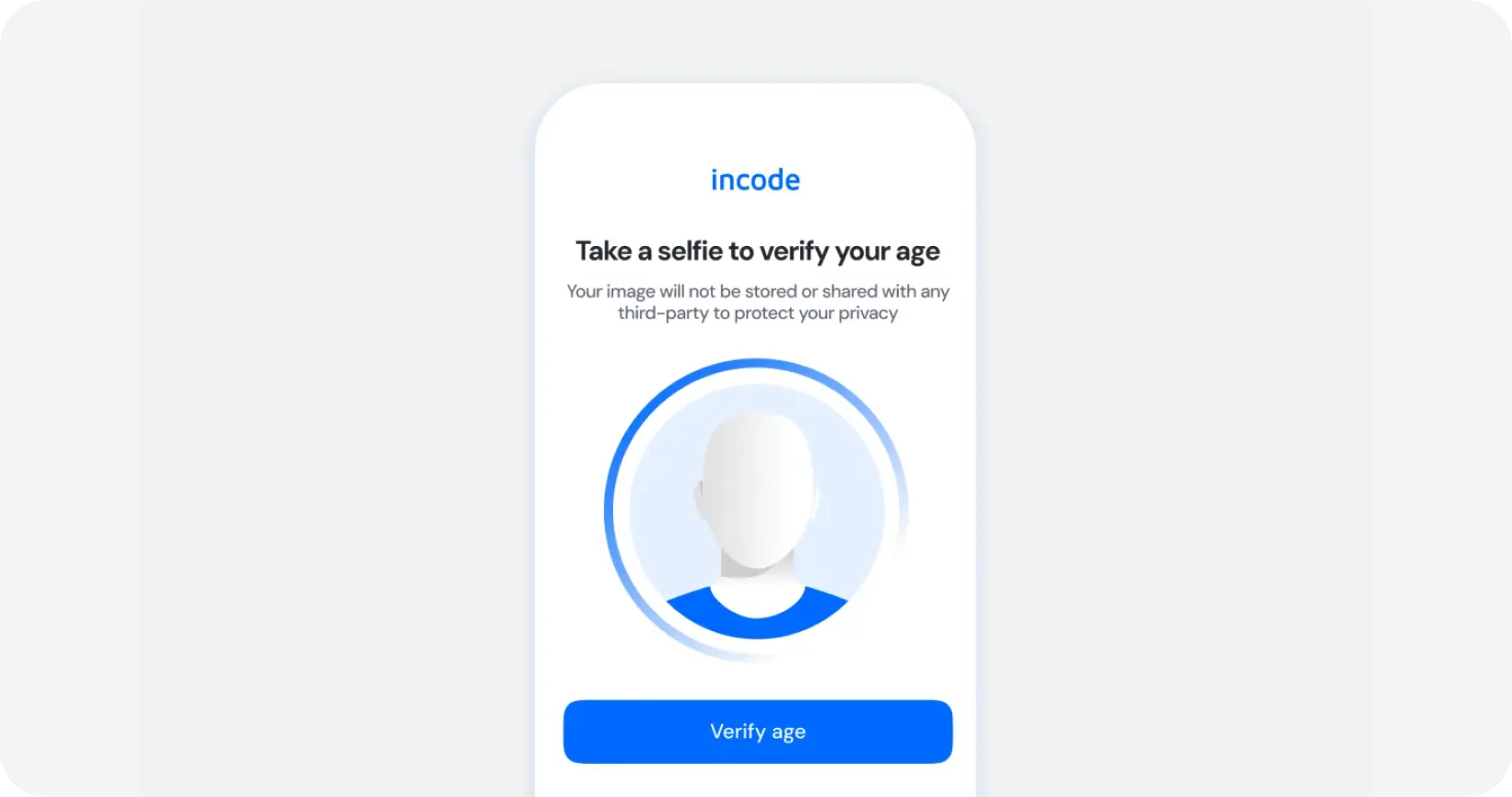
Platforms can also extend the privacy experience to what users see on screen during the age inference check. Rather than showing a live camera feed, Incode offers a privacy lens that blurs the user's face in real time, alongside other privacy-preserving options.
For users who are uncomfortable seeing their face on screen at all, these options close the gap between architectural and perceived privacy. For platforms, they are a brand alignment opportunity, making the verification experience feel intentional rather than intrusive.
Built for Platforms That Want to Give Users a Real Choice
On-Device Age Estimation is the privacy-preserving tier within Incode's full age assurance suite, available as a standalone option or as the first step in a waterfall. Platforms can offer users a meaningful choice: a standard flow, or one where their face never leaves their device.
Users who've experienced a data breach, operate in privacy-sensitive contexts, or simply read the fine print want the architectural assurance that their biometric data goes no further. Offering that option respects the full range of user expectations and builds the kind of trust today’s platforms require.
"We have always believed that privacy and fraud prevention are not a tradeoff, but part of the same problem, solved together or not at all." Ricardo Amper, Founder & CEO, Incode
Get Started With Incode On-Device Age Estimation
Regulations are accelerating. Half of all U.S. states enforce some form of digital age verification. The UK Online Safety Act is enforcing “highly effective” age checks now, with intent to restrict those under the age of 16 from accessing social media by Spring 2027. The Australian government is planning to double maximum fines in response to early non-compliance of a similar social media law. Brazil's Digital ECA took effect in March 2026.
The platforms that move now build compliance history before enforcement begins. They position themselves with regulators who are actively evaluating acceptable methods. And they give users a real choice backed by architecture, not just a policy.
On-device age assurance is on the same trajectory as HTTPS: optional today, table stakes tomorrow. The difference between the platforms that set that benchmark and those who respond to it is being decided right now.
Ready to give your users that option? Learn more about Incode On-Device Age Estimation, or review our suite of other age verification products.