

Glossary
Clear definitions for identity, trust, and fraud prevention.
0–9
A
- Fraud Account opening fraud Fraud at signup, before any legitimate use.
- Fraud Account takeover ATO A criminal getting into an existing customer's account.
- Biometrics Active liveness Asking the user to blink, turn, or smile to prove they are live.
- Compliance Adverse media screening Searching news for damaging coverage about a customer.
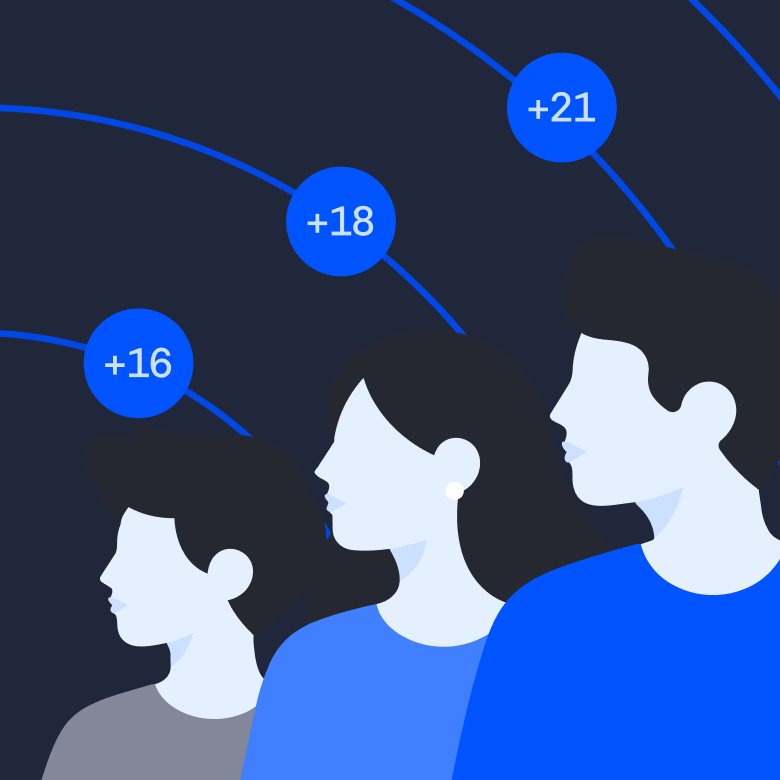
- Verification Age estimation Predicting someone's rough age from a signal like a selfie, voice sample, or account activity, most often a selfie, without collecting an ID.
- Verification Age verification Confirming someone is old enough, usually from an ID or trusted record.
- Agentic fraud Agent authentication How a website or service checks that an artificial intelligence (AI) agent really is the agent it claims to be, such as a specific shopping assistant from a specific company. It is a separate check from confirming the person the agent works for.
- Agentic fraud Agent hijacking An attack in which someone takes control of a legitimate artificial intelligence (AI) agent, usually by hiding instructions in content the agent reads, so it works for the attacker instead of its owner.
- Agentic fraud Agent impersonation When a malicious bot pretends to be a trusted artificial intelligence (AI) agent, such as a well-known shopping or banking assistant, so that a website lets it in and treats it as legitimate.
- Agentic fraud Agent mandate The specific permission a person gives an AI agent to act on their behalf, including what it can do and up to what limit.
- Agentic fraud Agent Payments Protocol AP2 An open protocol that lets an artificial intelligence (AI) agent pay on a person's behalf while carrying signed proof of what the person approved, either the exact purchase or the limits for one the agent makes later on its own.
- Agentic fraud Agent washing Calling a product an AI agent when it is really a simple chatbot, a fixed script, or ordinary automation that cannot plan or act on its own.
- Agentic fraud Agent-initiated dispute A dispute in which a cardholder asks their bank to reverse a purchase their artificial intelligence (AI) agent made, saying the agent was not allowed to make it, bought the wrong thing, or went beyond what they asked for.
- Agentic fraud Agent2Agent protocol A2A An open standard that lets artificial intelligence (AI) agents built by different companies find each other, hand off tasks, and send back results, so one agent can bring in another to finish part of a job.
- Agentic fraud Agentic commerce Shopping and payments in which an artificial intelligence (AI) agent finds, chooses, and pays for goods or services on behalf of a person or business, with the person setting the goal and the spending limits instead of clicking "buy" themselves.
- Agentic fraud Agentic fraud Fraud carried out by AI agents that plan and run the whole scam themselves, from first contact through cash-out, with little or no human directing it in real time.
- Agentic fraud Agentic Identity Confirming that an AI agent acting on someone's behalf is tied to a real, verified person and staying within what that person actually authorized it to do.
- Agentic fraud Agentic payment protocols Technical standards that let artificial intelligence (AI) agents pay on a person's behalf, by setting how an agent proves which agent it is, shows what the person allowed it to buy, and hands payment details to a merchant.
- Agentic fraud AI agent Software built on an artificial intelligence (AI) model that takes a goal from a person, works out the steps, and carries them out by using other tools and services, such as searching the web, filling in forms, or making a payment, with limited human input along the way.
- Agentic fraud AI washing Making a product, service, or company sound more advanced by exaggerating how much it uses artificial intelligence (AI), or what that AI can do.
- Platform Anomaly detection Spotting activity that doesn't match a person's or a system's usual pattern, like a sudden flood of orders from a location that normally has almost none.
- Compliance Anti-money laundering AML The rules and controls that stop illicit money entering the system.
- Fraud Application fraud Lying, or using a false identity, on an application to get something you would not otherwise receive.
- Platform Audit trail An unchangeable record of every check, decision, and reviewer action.
- Verification Authentication Checking that a returning user is the same person who signed up, every time they log in or attempt a sensitive action.
- Verification Authorization Deciding what a verified user is allowed to do.
B
- Verification Bank account verification Confirming that a bank account is real and belongs to the person or business that claims it.
- Compliance Bank Secrecy Act BSA The foundational US anti-money-laundering law.
- Biometrics Behavioral biometrics Recognizing someone by how they type, swipe, and hold the phone.
- Biometrics Biometric template The mathematical summary of a face, fingerprint, or other biometric trait, stored instead of the original image or recording.
- Biometrics Biometrics Identifying someone by a physical trait, such as their face, voice, or fingerprint.
- Compliance BIPA Illinois's biometric privacy law, and the litigation risk that comes with it.
- Fraud Bot attack Automated scripts hitting your signup or login at scale.
- Fraud Business email compromise BEC A scam where a fraudster impersonates an executive or trusted vendor, by email, voice, or now deepfake video, to trick an employee into wiring money or sharing sensitive data.
- Fraud Bust-out fraud Building good credit patiently, then maxing everything out and vanishing.
C
- Platform Case management The workspace where analysts review and resolve flagged cases.
- Compliance CCPA/CPRA California's consumer privacy law and its 2023 expansion, giving state residents rights over their personal data.
- Fraud Chargeback A forced refund a bank issues back to a customer's card after they dispute a charge, taken out of the merchant's account.
- Fraud Chargeback rate The share of transactions that end up disputed and refunded through a chargeback.
- Verification CIAM (Customer Identity and Access Management) A system that manages how customers prove who they are and what they can access across all of a company's digital products, not just at signup.
- Fraud CNP (Card Not Present) fraud Fraud committed on a purchase where the merchant never physically sees the card, most online and phone transactions.
- TrustGraph Confusion matrix A small table that shows how often a detection system was right and wrong.
- Compliance Consent Getting clear permission before collecting biometric or personal data.
- Platform Conversion rate The share of people who start verification and finish it.
- Documents Counterfeit document A fake ID made from scratch to look like the real thing.
- Fraud Credential stuffing Trying leaked username and password pairs against your site en masse.
- Compliance Customer due diligence CDD Understanding a customer's risk before and during the relationship.
- Compliance Customer identification program CIP The written rules a US institution follows to identify customers.
- Fraud Cyber-fraud fusion The merging of cybersecurity and fraud prevention into one connected defense, instead of two separate teams and tools that don't talk to each other.
D
- Fraud Data breach An incident in which sensitive data is exposed to people who should not have it.
- Documents Data extraction Pulling name, date of birth, and number off a document into your system.
- Compliance Data minimization Collecting only what you actually need, and keeping it only as long as you need it.
- Agentic fraud Data poisoning An attack that corrupts the data an artificial intelligence (AI) model learns from or looks up, so the model later makes wrong decisions that benefit the attacker.
- Compliance Data residency Keeping data physically inside a specific country or region.
- TrustGraph De-identification Removing or scrambling the details that point to a specific person, so data can be used without exposing who it is about.
- Platform Decisioning engine The component that says approve, decline, or review.
- Biometrics Deepfake AI-generated video, images, or audio of a person, often used by fraudsters to attempt gaining access to a locked account or service.
- Biometrics Deepfake detection Telling AI-generated faces apart from real captures.
- Biometrics Demographic differentials When a biometric works less well for some groups than others, based on traits like skin tone, age, or sex.
- Fraud Device fingerprinting Recognizing a device by combining details like its screen size, operating system, fonts, and browser settings into one identifier.
- Documents Digital forgery An ID that was never printed, but instead edited or generated on a computer.
- Verification Digital identity The full set of data, credentials, and traits, biometric, government-issued, or self-declared, that represents a specific real person online.
- Verification Digital identity wallet An app that holds your verified ID credentials so you can present them on demand.
- Documents Document coverage How many document types from how many countries a vendor can actually read.
- Documents Document liveness Confirming an ID document was captured live and in person right now, not photographed off a screen or reused from an earlier scan.
- Documents Document tampering Altering a real ID, for example by changing a date or swapping a photo.
- Documents Document verification Checking that an ID is real and unaltered.
- Platform Drop-off Where and why users abandon the flow.
- Biometrics Duplicate detection Spotting that a new applicant is already in your system.
E
- Compliance eIDAS 2 The EU regulation creating an official EU digital identity wallet.
- Compliance eKYC (Electronic KYC) Completing Know Your Customer checks entirely online, using a smartphone camera and an ID document, instead of visiting a branch in person.
- Fraud Emulator detection Spotting a fake phone, such as an app running on a simulated device.
- Compliance Enhanced due diligence EDD Digging deeper on the customers who carry more risk.
- Biometrics Equal error rate EER The point where false accepts and false rejects are equally frequent.
- Agentic fraud Excessive agency When an artificial intelligence (AI) agent can do more than its job needs, through extra tools, wider access, or freedom to act without asking, so a mistake or an attack causes more harm than it should.
F
- Biometrics Face match 1:1 Checking that a live selfie and the ID photo are the same person.
- Biometrics Face search 1:N Checking a new face against every face already in your system, either your own user base (to catch someone opening a second account under a different name), or an external watchlist of known fraudsters (to catch a repeat offender).
- Biometrics Face-swap deepfake A deepfake that replaces one person's face with another's in a video or photo, while keeping the original body and background.
- Biometrics False acceptance rate FAR How often the system wrongly says two different people match.
- Fraud False negative Real fraud that the system missed and treated as legitimate.
- Fraud False positive A good customer flagged as fraud.
- Biometrics False rejection rate FRR How often the system wrongly rejects the right person.
- Fraud First-party fraud Someone using their own real identity, intending never to pay.
- Documents Forged document A genuine document that has been altered to lie.
- Fraud Fraud Deception for financial or access gain.
- TrustGraph Fraud consortium A group of organizations that pool fraud information so each one can benefit from what the others have seen.
- Fraud Fraud rate What share of accounts or transactions turn out fraudulent.
- Fraud Fraud ring A coordinated group running the same attack across many accounts.
- Fraud Fraud-as-a-service Ready-made fraud tools and services sold or rented to anyone, the same way legitimate businesses buy software as a service, so running a scam no longer requires technical skill.
- Fraud Friendly fraud When a customer disputes a charge as unauthorized or undelivered, even though they actually made the purchase and received it.
- Fraud Fullz Slang for a complete package of stolen identity details about one person.
G
- Biometrics GAN (Generative Adversarial Network) The AI technique behind most deepfakes, where two AI models compete against each other until the fake becomes convincing enough to fool the other one.
- Compliance GDPR The EU's data protection law.
- Fraud Generative AI fraud Fraud that uses AI tools to create convincing fake faces, voices, documents, or messages.
- Verification Government source-of-truth validation Confirming that a person's identity actually exists and is in good standing in a government database, not just that their ID document looks real.
- Documents Government-issued ID A passport, driver's license, or national ID card.
H
I
- Verification Identity assurance level IAL A rating of how confident you can be that an identity is genuine.
- Verification Identity graph A fraud-detection tool that flags unusual clusters, like one device logging into 10 different accounts.
- Fraud Identity mule A real person who lends their identity so that criminals can control an account in their name.
- Verification Identity proofing Gathering and checking evidence about someone before they ever get an account.
- Verification Identity verification IDV Proving that a person is who they claim to be, usually by checking a form of ID against a live selfie.
- Fraud Impossible travel When the same account is used from two places too far apart for one person to have traveled between them in the time available.
- Agentic fraud Indirect prompt injection An attack in which someone hides instructions inside content an artificial intelligence (AI) agent will read, such as a web page, an email, a product listing, or a document, so the agent follows them without the user knowing.
- Biometrics Injection attack Feeding fake video straight into the app, bypassing the camera entirely.
- Fraud IP intelligence What an IP address tells you: location, VPN, hosting provider, and reputation.
J
K
- Agentic fraud Know Your Agent KYA Know Your Agent (KYA) is a risk-based framework for establishing and maintaining trust in AI agents that act for people or organizations: it defines each agent's identity, binds the agent to a responsible human or organization, and enforces policy and auditability across every action the agent takes. It extends Know Your Customer (KYC) from the human customer to the software acting on that customer's behalf.
- Compliance Know your business KYB The same duty, but for company customers.
- Compliance Know your customer KYC The legal duty to know who your customers are before serving them.
- Compliance Know your employee KYE Verifying the people you hire, contract, or grant access to.
- Agentic fraud Know Your Human KYH Know Your Human (KYH) is the set of checks that prove a real, present person stands behind an account, a session, or an AI agent, and that keep that person accountable for what the agent does on their behalf.
- Verification Knowledge-based authentication KBA Security questions about your history, for example, where you lived or what car you financed.
L
M
- Documents Machine-readable zone MRZ The two or three lines of code at the bottom of a passport.
- Fraud Manual review A human looking at the cases the system could not decide.
- Agentic fraud Model Context Protocol MCP An open standard that lets artificial intelligence (AI) applications and agents connect to outside tools and data, such as a calendar, a file store, or a company database, through one common method instead of a custom connection for each.
- Platform Model drift A model getting worse because the fraud patterns or user behavior it was trained on have shifted since launch.
- Fraud Money mule An account used to move someone else's illicit money.
- Biometrics Morphing attack Blending two faces into one photo that matches both people.
- Verification Multi-factor authentication MFA Requiring two or more different kinds of proof to sign in.
N
- Fraud Negative list / blacklist A list of specific addresses, emails, phone numbers, or card numbers a business has flagged as tied to past fraud, used to auto-decline anything matching them again.
- TrustGraph Network-based fraud detection Spotting fraud by looking across many organizations instead of inside just one.
- Documents NFC chip reading Tapping a passport or ID to read the chip inside it.
- Compliance NIST 800-63 The US standard for digital identity assurance.
- Biometrics NIST FRVT The US government's independent benchmark for face-recognition accuracy.
- Verification Non-document verification Confirming an identity from bureau or government records rather than a photo of an ID.
O
- Compliance OFAC The US Treasury office that runs American sanctions lists.
- Verification Onboarding The identity checks a new user goes through before they can use a product. The process typically includes submitting a document, taking a selfie, and waiting for a decision.
- Verification One-time passcode OTP A short code sent by SMS or email that expires quickly.
- Compliance Ongoing monitoring Keeping watch after onboarding, not just at signup.
- Documents Optical character recognition OCR Turning the text in a photo of an ID into data fields.
- Platform Orchestration Routing each user through the right checks instead of running all of them.
P
- Fraud P2P payment fraud Fraud that uses person-to-person payment apps to take money from people.
- Platform Pass rate How many genuine users get through on the first try.
- Biometrics Passive liveness Proving liveness invisibly, from a single normal selfie.
- Verification Passkey A phishing-resistant login that replaces the password with your device and face or fingerprint.
- Compliance PCI DSS The security standard every business that touches credit card data has to follow.
- Documents PDF417 barcode The dense barcode on the back of most US and Canadian driver's licenses.
- Compliance Perpetual KYC pKYC Refreshing customer records continuously instead of on a schedule.
- Verification Personhood Confirming that a real, live human is present at all, before ever checking which specific person they are.
- Documents Photo substitution Replacing the portrait on a real ID with someone else's face.
- Compliance PII (Personally Identifiable Information) Any piece of information that could be used to identify a specific person, such as a name, date of birth, or government ID number.
- Compliance Politically exposed person PEP Someone in a prominent public role, or close to one.
- Biometrics Presentation attack detection PAD Detecting when someone holds up a mask, printout, or screen to the camera.
- Agentic fraud Prompt injection An attack in which someone writes text designed to make an artificial intelligence (AI) system follow the attacker's instructions instead of the ones its developer gave it.
- Verification Proof of address PoA Confirming where someone actually lives.
- Compliance PSD2 The EU's rulebook for electronic payments, best known for requiring extra identity checks on most online purchases.
R
- Verification Re-verification Re-checking an existing user's identity when a specific trigger calls for it, such as a high-value transaction, an account recovery, or a scheduled compliance refresh.
- TrustGraph Repeat fraud The same fraudster, identity, or device attacking again after being caught, or moving on to attack other organizations.
- Verification Reusable identity Verify once, then reuse that verified identity elsewhere without starting over.
- Compliance Right to erasure A person's right to have their data deleted.
- Fraud Risk signal Any single data point that raises or lowers suspicion.
- Platform Rules engine Explicit if-this-then-that logic on top of the models.
S
- Compliance Sanctions screening Checking names against government prohibition lists.
- Platform Sandbox A test environment with fake data and forced outcomes.
- Documents Screen replay detection Catching a photo of a screen instead of a real document.
- Fraud Second-party fraud Fraud committed by someone the cardholder actually knows and gave access to, not a stranger and not the cardholder themselves.
- TrustGraph Secure multi-party computation SMPC A way for several parties to work out a shared answer together without any of them seeing the others' private data.
- Documents Security features Holograms, microprint, UV ink, and similar physical markers that are difficult to reproduce without specialized printing equipment.
- Verification Self-sovereign identity SSI A model where people, not companies, hold their own identity data.
- Biometrics Selfie verification Taking a selfie to prove you are the person on an ID or the owner of an account.
- Agentic fraud Shadow AI Employees using AI tools or AI agents for work that their organization has not approved or does not know about.
- TrustGraph Shadow mode Running a new control quietly in the background, without letting it change any real outcomes, so you can see how it would have behaved.
- Fraud Sleeper fraud Accounts opened with a fake or stolen identity and then left quiet before they are used for fraud.
- Compliance SOC 2 An audit of how well a vendor protects your data.
- Platform Software development kit SDK The prebuilt capture component you drop into your app.
- Biometrics Spoofing Any attempt to fool a biometric check with a fake.
- Verification Step-up authentication Asking for extra proof of identity, but only when a specific action, such as a large transfer, a new device, or a change to account recovery settings, raises the risk.
- Platform Straight-through processing STP The share of users decided automatically, with no human involved.
- Verification Strong Customer Authentication SCA A European rule requiring two separate proofs of identity, not just a password, to complete most online payments.
- Fraud Structuring / smurfing Breaking up a large sum of money into smaller transactions specifically to stay under the amount that triggers a bank's reporting requirement.
- Compliance Suspicious activity report SAR The confidential filing made when activity looks like financial crime.
- Biometrics Synthetic avatar deepfake A deepfake that generates an entirely fabricated person, including movement and expression, rather than swapping a face onto real footage.
- Fraud Synthetic identity fraud An identity built from a mix of real and invented data, describing a person who does not exist.
T
- Fraud Third-party fraud Using someone else's real identity without their knowledge.
- Agentic fraud Tool poisoning An attack in which a tool, plugin, or connector that an artificial intelligence (AI) agent relies on has been built or changed to mislead the agent, often with hidden instructions that tell it to leak data or misuse other tools.
- Platform Total payment volume TPV The total dollar value of transactions a platform processes over a period, before the platform's own fees come out.
- Compliance Travel Rule Sender and receiver information must travel with a transfer.
- Verification Trust score A single number summarizing how likely an identity is genuine.
- TrustGraph TrustGraph A privacy-preserving trust intelligence network that helps institutions spot repeat fraud across organizations, without pooling anyone's customer data.
- TrustGraph TrustGraph detection categories The kinds of fraud that TrustGraph is designed to flag.
- TrustGraph TrustGraph privacy guarantees Four rules that keep identities and institutions hidden every time TrustGraph runs a query.
U
V
- Fraud Velocity checks Watching how fast something is happening, such as five applications submitted in a minute.
- Verification Verifiable credential VC A digital document whose authenticity anyone can check cryptographically.
- Documents VLM (Vision-Language Model) An AI model that reads and understands the layout and meaning of a document, not just the individual characters on it, the way traditional OCR does.
- Biometrics Voice biometrics Recognizing someone by how their voice sounds.
- Biometrics Voice cloning Using AI to recreate a specific person's voice from a short recording, well enough to fool a phone call.
W
- Compliance Watchlist Any list of people or entities you must check against.
- Platform Webhook A callback that tells your system the moment a decision is ready.
- Fraud Whitelist / approve list The opposite of a blacklist: a list of people or details a business has flagged as trustworthy, so future orders from them skip extra scrutiny.
- Platform Workflow builder A visual editor for designing identity flows without code.
No terms match that search.