Anchor signals to verified biometric identities
TrustGraph anchors fraud and trust signals to biometric identities verified with Incode’s technology and government checks where available.
 Highlights
 Introducing TrustGraph
The first trust network built for the agentic era
Read more
Introducing TrustGraph
The first trust network built for the agentic era
Read more
 Age Center
Understand Incode’s approach to age assurance
Explore the Center
Age Center
Understand Incode’s approach to age assurance
Explore the Center
 Introducing GovFaceMatch
The first identity solution to match biometrics against DMV records
Read more
Introducing GovFaceMatch
The first identity solution to match biometrics against DMV records
Read more
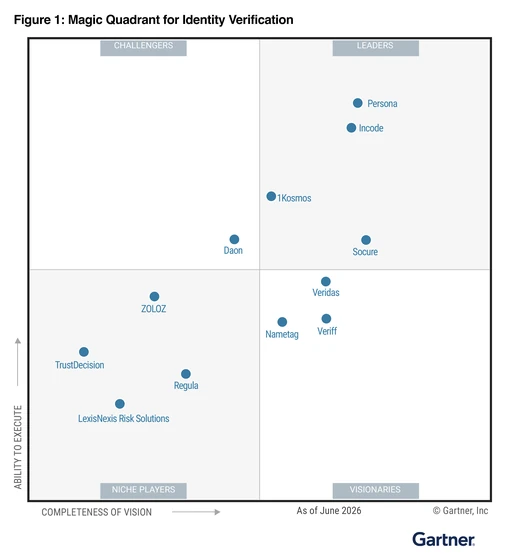 3 years in a row named a Leader
A Leader in the 2026 Gartner® Magic Quadrant™ for Identity Verification
Download the report
3 years in a row named a Leader
A Leader in the 2026 Gartner® Magic Quadrant™ for Identity Verification
Download the report
TrustGraph helps institutions detect repeat fraud, even when names, documents, or devices change, and recognize legitimate customers with less friction, without exposing customer data.
TrustGraph is already delivering results for leading companies









more fraud detected than with institutions' existing models alone.
Best-performing institution in Incode's Early Access Program.
invested in the patented privacy-preserving technology behind TrustGraph, through more than a decade of research.
Developed by Identiq, acquired by Incode in 2026.
What TrustGraph enables
Fraud crosses institutions, but the intelligence to detect repeat patterns stays isolated. TrustGraph’s privacy-preserving technology connects that intelligence across the network without pooling or exposing customer data.
TrustGraph anchors fraud and trust signals to biometric identities verified with Incode’s technology and government checks where available.
Privacy-preserving cryptography links participating institutions’ fraud intelligence without pooling, exchanging, or exposing customer records.
TrustGraph helps detect repeat fraud and recognize legitimate customers through positive trust signals, reducing unnecessary friction while institutions retain control over decisions.
Trusted by industry leaders

“TrustGraph brings the signals from individual clients together as a network. If Company A experiences something bad, we know the same actor will try Company B, and with Incode, Company B doesn’t have to face that attack as if it were the first time.”
Navjeet GrewalManaging Director, Verification and Digital Credentials, InteracCanada's payments and identity network connecting nearly 300 financial institutions.
The problem
Fraud used to scale with people, then with software. Now, AI agents can create false identities, forge documents, learn from rejected attempts, and launch thousands of variations of the same attack across institutions at machine speed.
of fraud attempts projected to be AI-driven by the end of 2026
Incode
more institutions targeted by repeat fraud offenders than five years ago
How it works
A privacy-preserving query rather than a shared customer-data pool.
What you gain
Surface repeat and coordinated activity your existing models cannot see alone.
Use trusted verification history to add positive context to risk decisions.
Bring related sessions together instead of reviewing them one by one.
Add network intelligence without creating a central pool of customer records. Customer records remain with the institution that holds them.
How it looks together
Secure multi-party computation enables privacy-preserving matching across participating institutions, with four privacy protections built into every query. The network is also being designed to include AI agents acting on behalf of customers.
The technology
Secure multi-party computation enables institutions to identify matching fraud and trust signals across the network without exposing each other's customer records.
Privacy
TrustGraph protects customer identities, conceals which institutions request and contribute signals, and prevents contributing institutions from seeing query outcomes.
There’s no central repository of customer records to breach.
Built for the agentic era
As AI agents open accounts and transact on behalf of customers, TrustGraph is designed to recognize them as participants in the trust network. Together with Agentic Identity, it will connect agents to verified people and enable trust and fraud signals across participating institutions.













Who is behind the agent
Agentic Identity verifies the person and the agent's authority to act for them.
The agent is a participant
Its activity becomes network signal: repeat fraud, or a trusted history.
Humans and agents, one network
Agent identity combined with cross-institution trust intelligence.
Native support for agentic activity is on the roadmap. Illustrative.
Traditional consortium approaches often rely on pooling or exchanging customer information to generate fraud intelligence. TrustGraph uses privacy-preserving cryptography to compare signals across participating institutions without creating a central repository of customer records.
TrustGraph uses patented peer-to-peer cryptography to connect fraud and trust signals across participating institutions without creating a central pool of customer records. Customer records remain with the institution that holds them; only protected cryptographic information is used to identify matches across the network.
No. TrustGraph provides risk and trust signals with explainable reason codes. Each institution applies its own risk policies to approve, review, request additional verification, or reject an attempt.
TrustGraph can surface positive trust signals for customers who have successfully verified at participating institutions, helping reduce unnecessary friction while maintaining existing decisioning controls. When a fraud signal and a trust signal both appear, the fraud signal wins.
TrustGraph returns six signal categories: suspected repeat fraudster, first-party fraud, unusual activity, velocity, fraud ring risk, and an approval boost trust signal. Each signal comes back with the reason it fired and without a customer record, and when a fraud signal and a trust signal both appear, the fraud signal wins. See every signal TrustGraph returns.
What's next