How AI-First Identity Verification Enables Privacy at Scale

Incode
June 25, 2026•
June 25, 2026•
Identity verification (IDV) has always required a certain level of trust.
When users hand over a selfie, a government-issued document, or a few seconds of their face in motion, they trust that the system verifying these items will do so quickly, accurately, and responsibly. Moreover, they expect data-sharing and retention will be minimized in accordance with relevant regulations.
Yet for much of the industry’s history, IDV has required a human reviewer as a standard verification step. Someone, somewhere, looked at the data. That was the standard. But it was also a structural privacy problem hiding in plain sight.
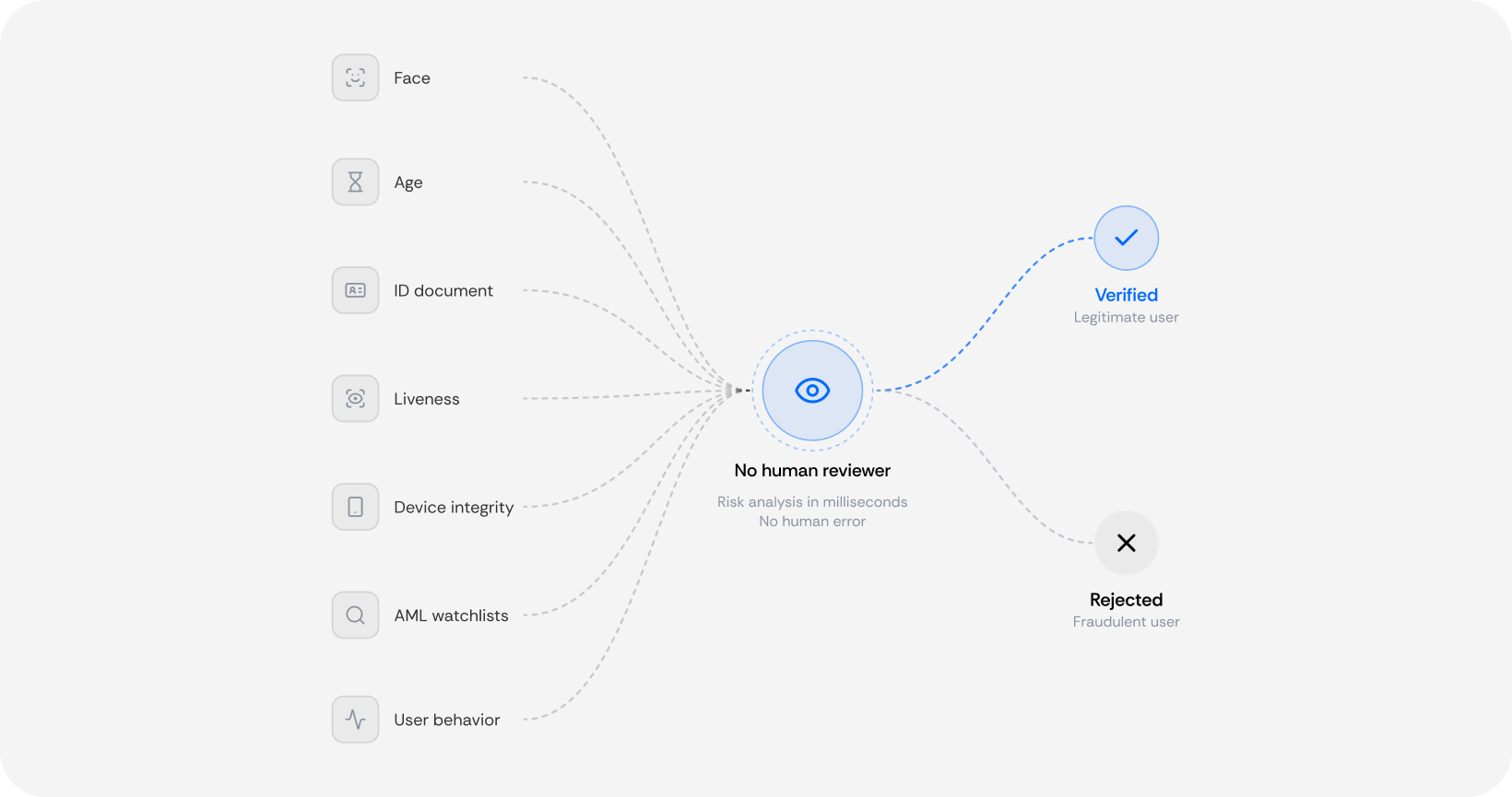
At Incode, we’ve been charting a different path since day one. We built our standard identity verification flow to be AI-first: Our proprietary AI models handle biometric matching, liveness detection, and document verification. Human review exists as a configurable step for edge cases, escalation, and compliance workflows, but is not toggled by default.
That architectural choice has enabled us to offer Identity Verification that is truly private-by-design.
For years, manual, human-led review remained the default choice for IDV. There are three main issues with this system: it’s too slow, it’s costly to scale, and it invites unnecessary risk.
With manual review, every verification attempt becomes an access point. When a human reviewer sees a user's face, document, or biometric data, they create an unnecessary vector for breach. Multiply that across millions of verifications and the exposure adds up fast.
Furthermore, the accuracy argument for human review has also weakened significantly. Research shows that humans can only detect deepfake faces in images roughly 50% of the time. That is no better than a coin flip. And for one of the most critical fraud signals in modern IDV, it simply doesn’t suffice. The case for keeping humans in the standard loop, on accuracy grounds alone, no longer holds.
Manual review is no longer the gold standard for IDV. It cannot scale to keep pace with modern fraud, and beyond that, it invites unnecessary risk by introducing third-party access to sensitive consumer data.
Every unnecessary human touchpoint is both a privacy risk and a performance liability. We have worked toward manufacturing it out of standard verification flows since 2015.
At Incode, AI-first has a precise architectural meaning: in our standard verification flow, AI-powered verification, liveness detection, and document analysis run without manual human review. Automation is the primary approach, full stop.
Our architecture preserves human review as a configurable option. Customers can trigger escalation paths for edge cases, compliance workflows that require human sign-off, or specific scenarios where additional review is appropriate.
The key distinction: human access to biometric and identity data is minimized by design. The system is built to lessen the number of people who ever need to see a user's sensitive information in the first place.
This is a deliberate, day-one decision. We built toward it from the start. Today, we’re standing behind that decision as we look toward the future of privacy-first IDV.
Reducing human access to sensitive consumer data produces a meaningful privacy outcome, and an efficiency gain on top of it. Designing a system where AI handles the standard flow means fewer people ever need access to biometric and identity data at scale.
This connects directly to our broader commitment to privacy. In 2026, Incode is investing more than $100 million toward privacy-preserving infrastructure. AI-first verification is one of three core architectural decisions that make that commitment real, alongside on-device processing and the cryptographic peer-to-peer fraud collaboration we unlocked through our acquisition of Identiq.
All three decisions rest on the same conviction: privacy and fraud prevention are the same problem, and they need to be solved together.
There is another dimension to the AI-first decision that matters increasingly as the industry evolves, and it has direct implications for IDV.
Gartner projects that 40% of enterprise applications will embed task-specific AI agents by the end of 2026, up from less than 5% in 2025.
As agents proliferate, a new verification challenge is emerging alongside the familiar one. Traditionally, IDV has focused on verifying humans. Increasingly, enterprises also need to verify the agents acting on humans' behalf. This has given rise to what the industry is calling Know Your Agent (KYA), an extension of the KYC framework designed to confirm an agent's identity, permissions, and scope of authority before it can transact or access sensitive systems.
Building AI-first from the start means Incode's architecture is positioned for both sides of this shift. When automation is the primary mechanism rather than a layer applied on top of a human-centered process, the system is structurally ready for the next generation of identity workflows. Agentic readiness follows directly from building AI-first from the start.
The IDV industry has historically treated privacy as a compliance requirement: a policy to write, a certification to maintain, a box to check. Incode has always treated it as an architectural requirement.
AI-first verification is one concrete expression of that. When the system is designed to minimize human access to sensitive data by default, the privacy benefit is structural. It does not depend on a policy being followed correctly. It does not require users to trust that their data will be handled well. The architecture simply produces fewer unnecessary access points.
That is the standard we held ourselves to on day one. It is the standard we are continuing to build toward.
To learn more about our commitment to privacy as architecture, visit the Incode Privacy Hub.
%20(1).avif)