On-Device Processing: The Next Step in Privacy Architecture

Milo Flores
June 25, 2026•

June 25, 2026•
Traditionally, digital identity verification (IDV) flows have required sensitive data, including biometrics and ID scans, to leave the end user’s device. This server-side strategy was necessary to accurately and efficiently verify the user’s identity or age.
However, this flow introduces one key structural problem that no privacy policy can solve. As long as a user’s biometric data travels from a device to a server, someone has access to it. The exposure is unintentional, yes. But it’s also part and parcel of the system’s design.
At Incode, we have spent over a decade building toward a different model: one where the analysis happens on a user’s device, the result is generated locally, and no identifying information ever moves. In this article, I’ll explain why on-device processing matters, how it works, how we approach it at Incode, and where we are taking it next.
When a digital service needs to verify an end user’s identity or confirm their age, the standard industry approach routes their biometric data to a remote server. The server runs the analysis, returns a result, and typically retains some record of the transaction. That means a user’s face, or a mathematical representation of it, has traveled across a network, touched external infrastructure, and existed somewhere outside their control.
On-device processing, on the other hand, runs all identity and age checks locally. The AI models that power the analysis are bundled directly into the application and run on the device's own processor. No network call is made to perform the inference. The computation starts and finishes locally, and the result is generated without the underlying data ever leaving the hardware in your hand.
At no point does an image, a biometric template, or any raw personal data get transmitted. There is nothing to intercept because analysis and confirmation occurred entirely on-device.
.png)
In a server-based model, all checks, including biometric ones, occur on infrastructure that the vendor controls. On-device, Incode's models only run lightweight server-side checks to verify non-biometric integrity signals, including anonymized device metadata, behavioral context, and session fingerprints. These signals verify liveness and thwart injection attacks. But the information is never accompanied by a face, biometric, or identity document.
The architecture is designed so that Incode has no technical pathway to a user's raw biometric data. Full stop.
In a server-based model, privacy is a policy. In an on-device model, privacy is a technical fact. There is no server to breach because there is no server involved.
A privacy policy can be carefully written and still leave users’ data sitting on a server somewhere. On-device processing removes that complication by prohibiting the transit of sensitive data to begin with. If data never leaves the device, it cannot be intercepted in transit, stored without the user's knowledge, or accessed in a breach they will read about years later.
“Safe” and “inaccessible” are not the same thing. Traditional IDV workflows prioritize the former. We are taking a stand on the latter.
As of 2024, third-party dependencies are responsible for more than one-third of all data breaches. IBM’s 2025 Cost of a Data Breach report identifies third-party and supply chain compromise as the second most prevalent and second costliest attack vector at $4.91 million per incident on average.
Users are increasingly aware of the enlarged attack vector presented by third-party vendors, and it’s impacting their perception of biometric collection. According to the Identity Theft Resource Center, 63% of consumers have serious concerns about providing biometric information, despite two-thirds agreeing that biometrics reduce identity-related crimes.
On-device processing is a critical step toward addressing increasingly negative consumer sentiment while providing essential IDV and age verification services.
We believe no organization needs to choose between protecting users and serving them. This reflects our day-one conviction that privacy and accuracy are not a tradeoff.
On-device processing enables us to verify users without exposing their data to third parties, thereby protecting both end users and our customers from breach. As such, we’re committed to investing heavily in its development and implementing on-device capabilities throughout our product line.
Incode is committing more than $100 million to privacy infrastructure, expanding on-device processing capabilities, deepening cryptographic R&D, and building the engineering capacity required to scale these protections to billions of annual verifications.
We are excited to launch On-Device Age Estimation, our first on-device processing use case.
Age assurance and verification are becoming an incredibly pressing challenge across all industries. Regulations across the globe are pushing platforms to verify their users’ ages proactively. As of June 2026, over 20 states enforce age-verification laws for websites considered “harmful for minors,” with federal legislation on the way. The UK just recently announced that minors under the age of 16 will be prohibited from social media by 2027, following in Brazil’s footsteps.
These sweeping regulations mean that secure, user-friendly age assurance technology is going to be even more essential moving forward.
Incode's On-Device Age Estimation delivers exactly that. A facial scan is analyzed entirely on the user's device. No image is transmitted. No biometric data leaves the phone. The result is an age determination generated locally, carrying no identifying information.
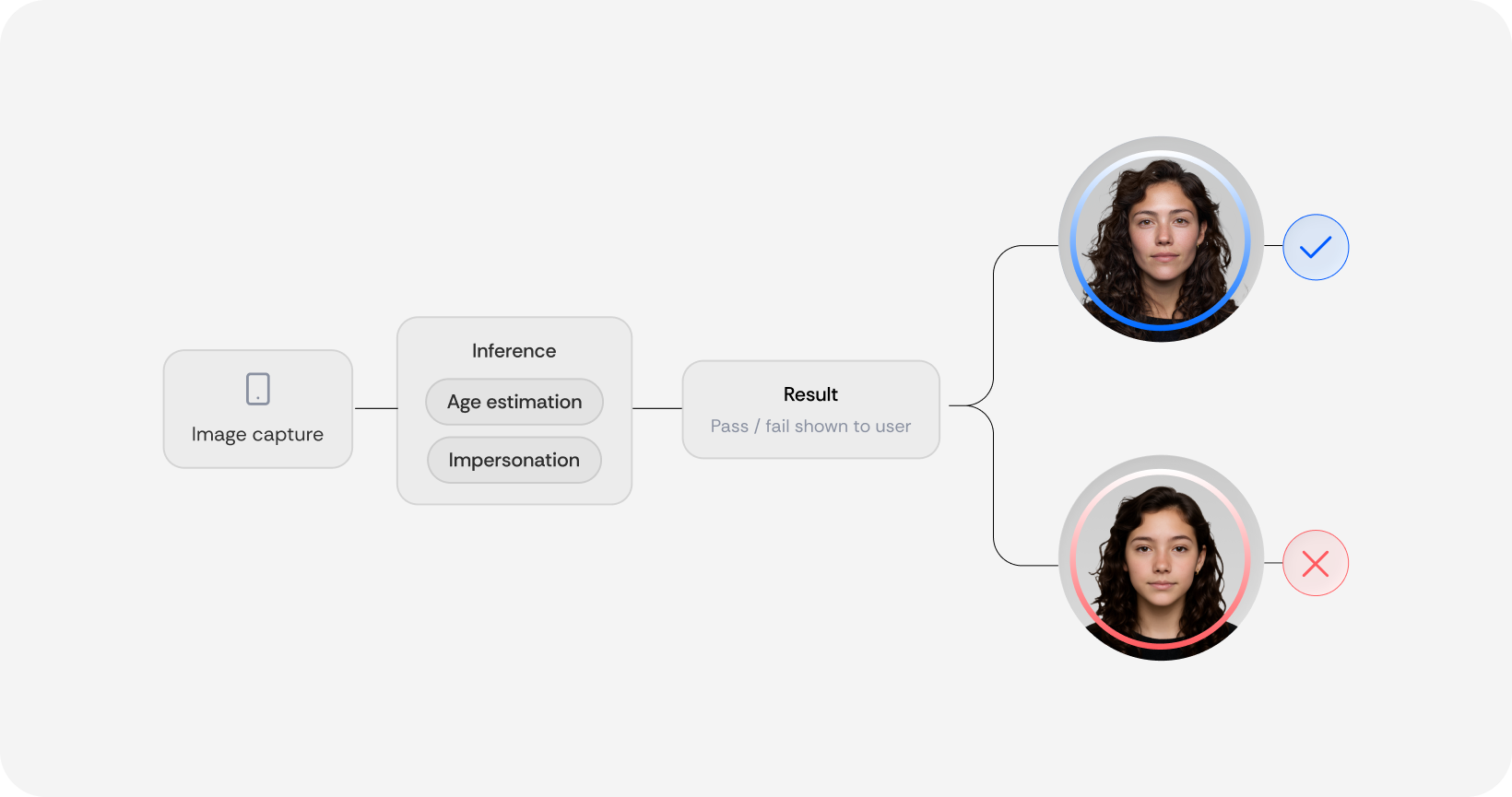
On-device does not mean unprotected. The same architecture that keeps biometric data local also detects and blocks spoofing attempts: deepfakes, injection attacks, replay attacks, 3D masks, and virtual cameras, all without transmitting any data. Privacy and security are not in tension here. They are achieved by the same design.
The process works in four steps:
The result: 92% of users complete the age check on the first try, with no document upload, no retry loop, and no escalation to a manual review queue.
The IDV industry has spent years telling users their data is safe. Most of those statements were made in perfectly good faith. The problem is that “safe” and “inaccessible” are not the same thing, and as users become more privacy-sensitive, they’ve learned to understand that difference keenly.
Our commitment to on-device processing is a commitment to close that gap permanently. When the architecture makes it technically impossible to access a user's face, there is no policy to scrutinize, no certification to verify, and no contractual clause to parse. The data never existed on a server. That is the standard we are holding ourselves to, and it’s one we’re proud to stand behind.
To learn more about our commitment to privacy as architecture, visit the Incode Privacy Hub.
%20(1).avif)