Consistency
Consistent policy enforcement
You set your compliance policy once, and Incode applies it the same way to every customer. The gaps and skipped steps that examiners flag disappear.
 Highlights
 Introducing TrustGraph
The first trust network built for the agentic era
Read more
Introducing TrustGraph
The first trust network built for the agentic era
Read more
 Age Center
Understand Incode’s approach to age assurance
Explore the Center
Age Center
Understand Incode’s approach to age assurance
Explore the Center
 Introducing GovFaceMatch
The first identity solution to match biometrics against DMV records
Read more
Introducing GovFaceMatch
The first identity solution to match biometrics against DMV records
Read more
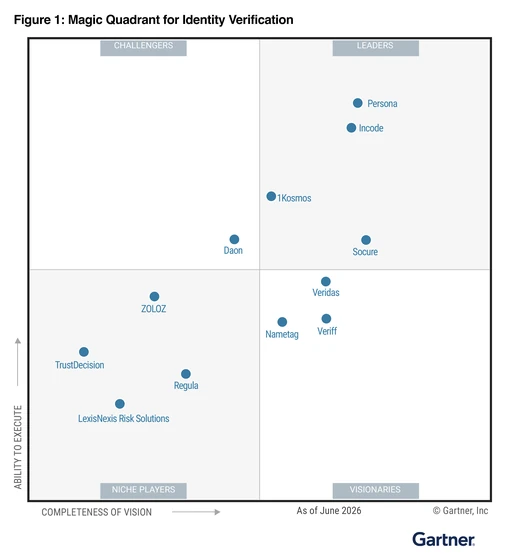 3 years in a row named a Leader
A Leader in the 2026 Gartner® Magic Quadrant™ for Identity Verification
Download the report
3 years in a row named a Leader
A Leader in the 2026 Gartner® Magic Quadrant™ for Identity Verification
Download the report
Incode runs Know Your Customer (KYC) and anti-money laundering (AML) compliance in one flow. It verifies every customer, applies the right level of due diligence, screens for financial-crime risk, and keeps an audit-ready record of every decision.
The challenge
Regulated institutions must verify who every customer is, check how much risk each one carries, screen them against sanctions and watchlists, and keep records that stand up to a regulator or auditor.
In practice, that work is spread across identity tools, screening vendors, manual review queues, and disconnected logs. The program becomes hard to run consistently. It becomes even harder to prove, because examiners expect evidence on demand.
TD Bank's 2024 penalty for anti-money-laundering failures, with a criminal guilty plea for failing to maintain an adequate program
DOJ / FinCEN / OCC, 2024
of that penalty imposed by FinCEN, the largest ever against a US depository institution
FinCEN, 2024
How it works
Verify identity, assess risk, screen for financial crime, then decide and record. Incode captures evidence at every step.
Why Incode
Identity checks, financial-crime screening, risk decisions, manual review, and audit evidence run in one system rather than stitched across vendors.
Consistency
You set your compliance policy once, and Incode applies it the same way to every customer. The gaps and skipped steps that examiners flag disappear.
Evidence
A structured trail preserves every input, check, and decision. You produce evidence for an exam or audit on demand rather than reconstructing it after the fact.
Ownership
Incode builds its core identity, biometric, liveness, and orchestration technology in-house. Institutions get a defensible, controllable program and a faster response when rules or threats change.
Scale
The same configurable system adapts verification methods, screening sources, and policy rules per jurisdiction. A global institution runs one KYC program rather than many.
Use cases
From banks to crypto, the same configurable program applies the right diligence and keeps the proof.
Meet Bank Secrecy Act identification and due-diligence requirements, with evidence ready for examiners.
Meet partner-bank and regulator expectations without slowing onboarding.
Apply risk-based diligence at account opening, before the account can transact.
Meet the identity and anti-money-laundering checks that regulators and licensing frameworks require.
Adapt verification methods, screening sources, and policy rules per market on the same program.
Methods
Every customer runs through the same core identity and screening stack.
Case management and audit trail
Gives reviewers full customer and session context, manages cases and assignments, and preserves every action as audit evidence.
Configurable policy and orchestration
Turns your compliance policy into automated workflows. The same rules apply to every customer and update as regulation changes.
Step-up and enhanced due diligence (EDD) workflows
Requests more identity evidence, stronger biometric verification, proof of address, or supporting documents when risk is elevated.
We made privacy a founding conviction long before regulation or the market asked for it. Incode's AI-first identity verification reduces fraud while remaining private and compliant.
Incode stores an encrypted biometric template rather than the raw image, processes on the edge where possible, and encrypts data in transit and at rest. The posture fits BIPA- and GDPR-conscious deployments.
Verified proof













7.1B+
trust checks run on the Incode platform
~4 sec
average KYC check
98%
first-try pass rate
8 of 10
top U.S. banks choose Incode
What customers say
“Stepping up our higher-risk members to document and biometric verification lets Chime keep real people moving while catching more fraud, and Face Login now protects peer-to-peer payments too.”

Operations Manager · Chime
KYC (Know Your Customer) verification is a regulatory process where financial institutions confirm customer identity, assess risk, and screen against sanctions and watchlists before opening accounts or processing transactions.
KYC is the process of verifying customer identity and understanding their risk profile. AML (anti-money laundering) is the broader set of laws and controls designed to prevent financial crime. KYC is a core component of any AML compliance program.
Customer Due Diligence (CDD) is the standard identity and risk verification required for all customers. Enhanced Due Diligence (EDD) adds deeper background checks, source-of-funds analysis, and closer scrutiny for high-risk individuals such as politically exposed persons (PEPs).
Standard KYC documentation includes a government-issued photo ID (a passport, driver's license, or national ID) and proof of address. High-risk or enhanced due diligence (EDD) cases may require additional documentation.
AI-powered KYC platforms reduce verification time from days to seconds. Incode completes the average KYC check in about four seconds with a 98% first-try pass rate, significantly reducing manual review queues.
Incode supports the core controls of the US Bank Secrecy Act:
· The Customer Identification Program (CIP), which verifies who each customer is
· Risk-based Customer Due Diligence (CDD) and Enhanced Due Diligence (EDD)
· Screening against sanctions, watchlists, adverse media, and politically exposed persons (PEPs)
· The recordkeeping that keeps a program audit-ready
The institution owns its program, policies, and filings. Incode provides the identity, screening, and evidence capabilities that support them.
A structured, auditable trail preserves every input, check, and decision, so you produce evidence for an exam on demand rather than reconstructing it after the fact. You encode policy once, and Incode applies it the same way to every customer, removing the skipped steps examiners flag.
Identity verification, AML screening, risk-based diligence, decisioning, EDD, and case review run in one system rather than stitched across separate identity, screening, and case tools. That is what makes consistent enforcement and on-demand evidence possible.
Yes. The same configurable program adapts verification methods, screening sources, and policy rules per market, without re-platforming. Examples include the EU's anti-money-laundering rules (AMLR and AMLD6) and the UK's Money Laundering Regulations. In Mexico, the same program meets the banking regulator's requirements (CNBV) and the federal anti-money-laundering law (LFPIORPI).
Yes. Incode supports the identity and AML checks required by FinCEN, the US financial-crimes regulator, by the Financial Action Task Force (FATF), and by emerging crypto licensing frameworks. High-volume onboarding runs with real-time sanctions screening and full audit trails, essential for crypto exchanges, wallets, and decentralized finance (DeFi) platforms operating under KYC obligations.
For this use case, yes. Incode screens each customer at onboarding, before the account opens. Periodic rescreening and ongoing monitoring are separate needs, and related Incode capabilities cover them: Business Verification (KYB) for entities, and account takeover protection for every login after the account opens.
Entity KYC and ultimate beneficial owner (UBO) checks live under Business Verification (KYB). This page focuses on verifying individual customers and keeping that work auditable.
What's next
See how Incode verifies every customer, applies the right diligence, and keeps the evidence ready.