A Year on the Front Line of Deepfake Fraud: What We're Bringing to Money 20/20
.jpg)
Fernanda Sottil
June 1, 2026•
June 1, 2026•
In 2026, identity stopped being a checkpoint you pass through. It became the accountability layer behind almost every meaningful interaction. The question is no longer "can this person get in?" but rather, "what is this entity allowed to do, and who is responsible when things go wrong?”
That shift is happening at exactly the moment deepfake fraud has gone industrial. The World Economic Forum recorded more than $200 million in deepfake-related fraud losses in Q1 2025 alone. Deloitte estimates AI-driven fraud in the US could approach $40 billion by 2027. Attackers can now generate tens of thousands of synthetic identities in real time, and enterprises are still catching up. After a record-breaking year of deepfake escalation, it’s imperative that banks level up their fraud defenses in 2026 and beyond.
That is the conversation I'll be joining at Money 20/20 Europe as a speaker on the panel Fighting Deepfakes: A Bank's Year on the Front Line. And honestly, I cannot wait.
I'm genuinely excited about this lineup, because everyone brings a perspective you rarely get to hear side by side.
Thomas Rubens, Managing Partner at DN Capital**, will be moderating. Thomas co-leads DN's software sector team and has backed category-defining companies from Seed to IPO, including Auto1, HomeToGo, Yassir, and Incode, where he led our Series A and serves as a board member. He has seen which identity bets actually pay off, and which ones look great on a pitch deck but collapse in production.
Ahron Geminder, Head of Product B2B at Vanguard Asset Management**, brings the builder's view. Before Vanguard, Ahron spent eight years at HSBC building the bank's global digital identity platform. If you want to know what it actually takes to ship identity infrastructure at the scale of a global bank, Ahron has the scars and the lessons.
Moderator, investor, and operator on the same stage. Three angles on the same hard problem.
Deepfakes are usually framed as a media problem: a fake face, a fake voice, a manipulated video. The real impact is structural. When a face, a voice, and a story can be generated on demand, looking legitimate becomes a commodity, and every identity system built on a one-time check at the door starts to break.
A year ago, the industry was still debating whether deepfakes would scale. They have. Fraud has shifted from identity reuse to identity fabrication at industrial scale. The uncomfortable part? Much of this fraud is not even being counted as fraud. It gets categorized as normal customer activity, and only surfaces months later as charge-offs, mule activity, or account takeover.
As Incode's Founder & CEO Ricardo Amper has written, the real challenge is stopping fraud without strangling the legitimate customer experience that drives the business.
The session moves through the problem in four parts, driven by questions the industry has not fully answered yet:
This session is built for fraud leads, AML and KYC operations, compliance officers, CISOs, IAM leaders, security architects, and trust and safety teams. If you own any part of how your organization decides who, or what, gets to act, this conversation is for you.
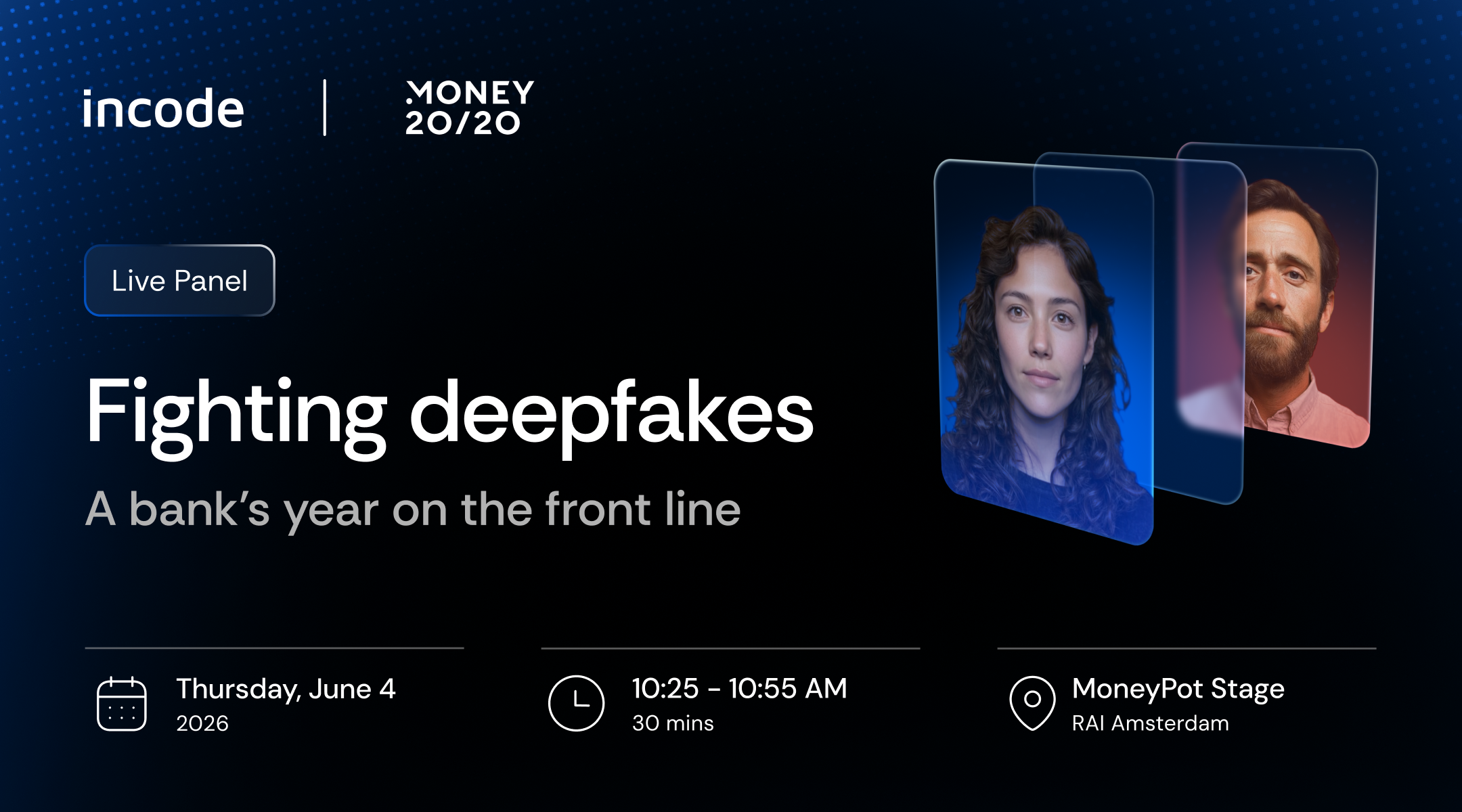
Fighting Deepfakes: A Bank's Year on the Front Line
🗓 Thursday, 4 June, 10:25–10:55 (30 mins)
📍 MoneyPot Stage, The RAI, Amsterdam
🎟 Inside Money 20/20 Europe
Come hear what a year on the front line actually taught us. And if you're at the event, come say hi to the Incode team. I'd love to meet you.
%20(1).avif)