




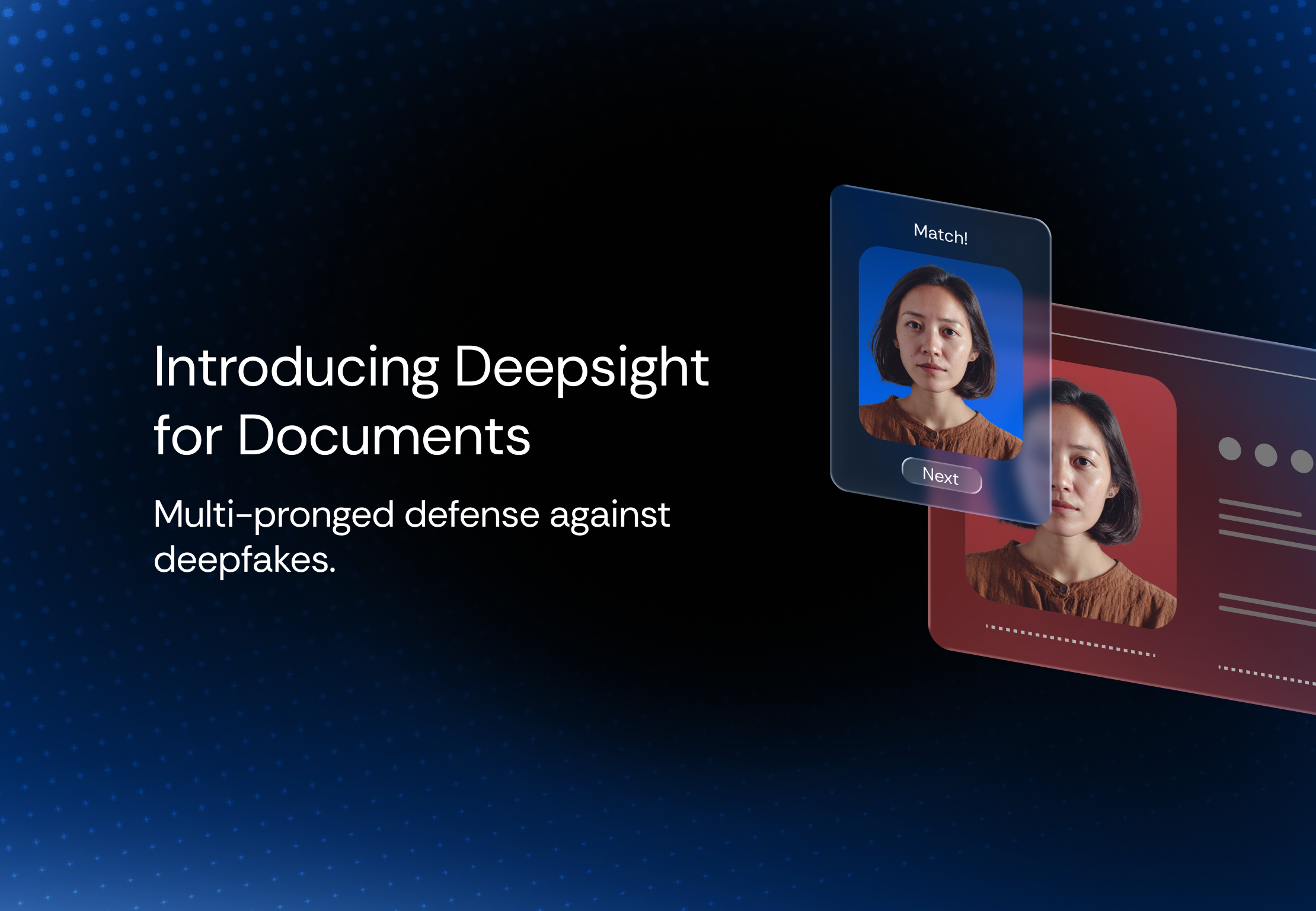
Introducing Deepsight for Documents. The Most Accurate Multi-Layer Defense Against Synthetic IDs
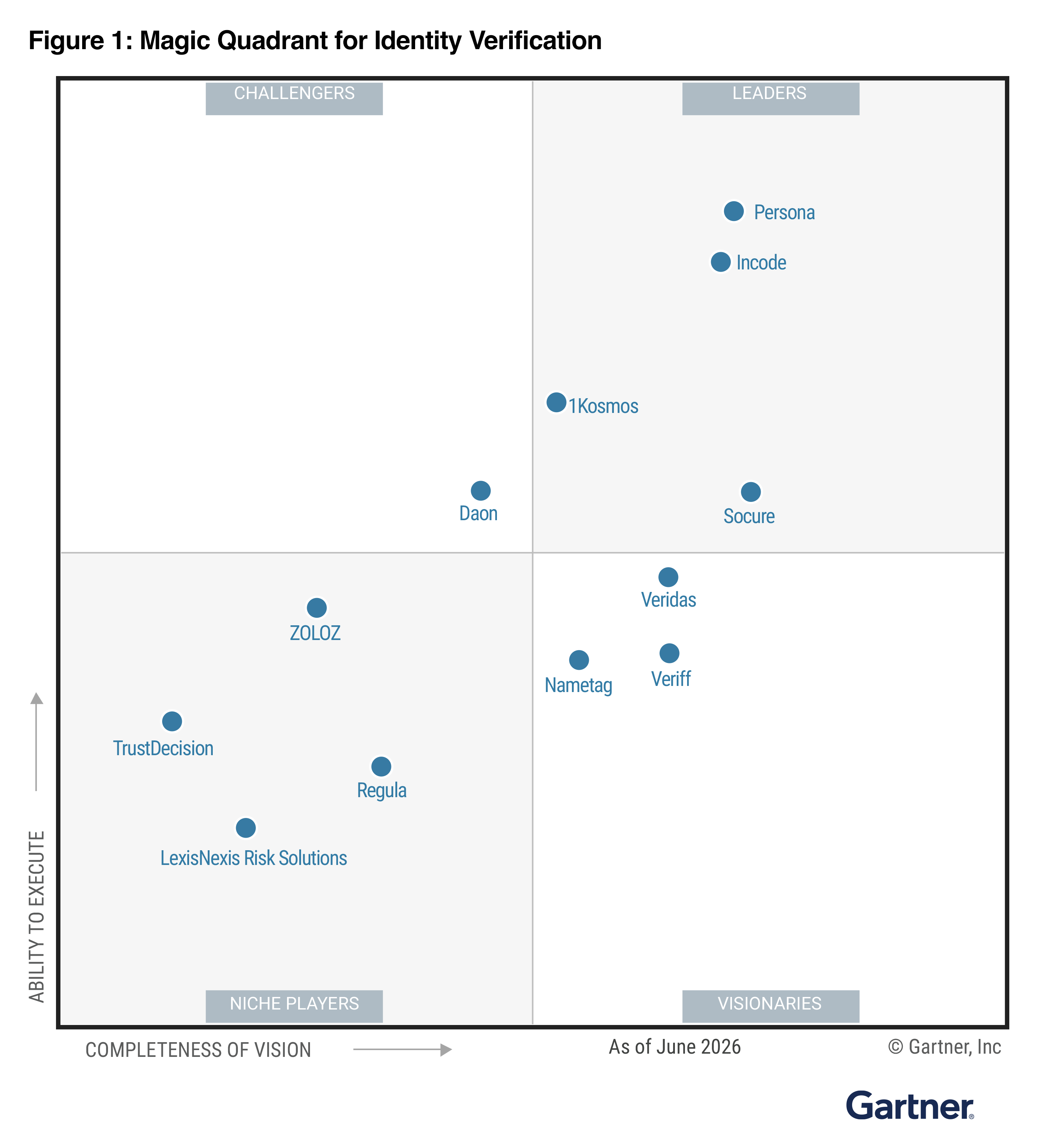
Today, Incode launched Deepsight for Documents, expanding the world’s most accurate Generative AI detection system to the document layer. Compared to traditional document checks, Deepsight for Documents is 8.8x more accurate at detecting and stopping AI-generated identity documents. This is critical in a world where 25% of all identity fraud attempts are now AI-assisted.
AI Document Fraud Is Increasing Rapidly
It has never been easier to generate a synthetic identity document. Underground platforms like OnlyFake and VerifTools enable fraudsters to create highly convincing identity documents, including passports and driver’s licenses, at scale and in seconds, often for minimal cost.
At the same time, frequent, large-scale breaches of personally identifiable information (PII) are giving fraudsters access to real names, dates of birth, and other sensitive data, increasing the credibility of these synthetic identities:
- In January 2025, Conduent experienced a cyberattack that resulted in the breach of 25 million Americans’ PII.
- In April 2024, a National Public Data (NPD) breach exposed 2.9 billion records, including social security numbers (SSNs), full names, and addresses.
- In February 2024, a UnitedHealth breach exposed the PII of 192.7 million patients.
Over the past two years alone, Incode has observed a 9.7x increase in GenAI-driven document fraud attempts. This trend will only accelerate as generative AI continues to advance.
Introducing Deepsight for Documents
Today, Incode is expanding Deepsight to the fastest-growing attack surface: fully synthetic identity documents.
Deepsight for Documents detects AI-generated and injection-based document fraud directly within existing identity verification flows. It operates as a native detection layer within the Incode Identity Platform, requiring no integration effort and causing no disruption to existing flows.

How Deepsight for Documents Works
Deepsight for Documents evaluates document authenticity across three coordinated detection layers:
- Behavioral signals confirm that the document was captured during a real, live session, flagging patterns consistent with automated or scripted submission.
- Device integrity signals confirm that the document originated from a legitimate, uncompromised device, detecting emulators, rooted or jailbroken devices, and virtual camera injections that attempt to override the capture feed entirely. Injection attacks are the fastest-scaling vector: by replaying synthetic document frames during live sessions, fraudsters transform individual fraud attempts into high-volume, automated pipelines.
- Perception-layer analysis, powered by Incode’s Vision Language Model (VLM), reasons jointly over visual and semantic document features, catching pixel-level generation artifacts, diffusion textures, structural inconsistencies, font-text mismatches, barcode and MRZ anomalies, and layout irregularities that template checks and barcode validation were never built to surface.
The VLM is trained on documents generated by the same tools fraudsters use, including VerifTools, OnlyFake, and other advanced fraud tooling, as well as consumer-grade image and video generation models, alongside real production data, digitally altered documents, template recreation attacks, and internal red-team adversarial datasets.
Incode has also built a structured synthetic generation pipeline that mirrors real-world fraud tooling. This creates a continuously expanding adversarial dataset that evolves alongside emerging threats.
Because detection relies on learned signals rather than static templates, the model generalizes across new document types, jurisdictions, and generation tools—including those it has not encountered during training.
Proven Performance
Deepsight for Documents catches 8.8x more fraudulent sessions than traditional document checks alone. Its false rejection rate of just 0.04% means the system stops fraud without creating friction for legitimate users.
On a controlled red-team dataset designed to deceive human reviewers, Deepsight for Documents achieved a 100% detection rate, compared to just 40% for standard identity verification alone.
Why Legacy Systems Fall Short
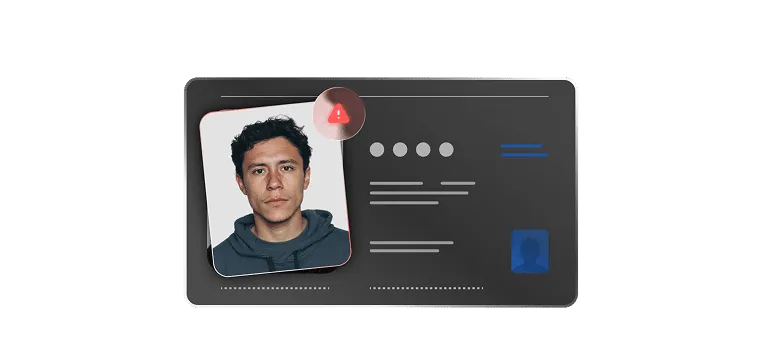
Template-based checks, barcode validation, and rules-based fraud detection often fail to detect AI-generated documents. In many cases, these synthetic documents can even fool human reviewers.
That’s because the documents appear correct: they contain real data, follow valid formats, and are specifically engineered to pass traditional checks.
Deepsight for Documents was built to address this gap. It detects the subtle artifacts of AI generation that legacy systems cannot surface, all while running natively within the Incode verification flow.
Stop AI-Generated Document Fraud at the Source
Fraudsters are no longer inventing identities or manually editing documents. Instead, they’re combining advanced AI generation with real PII to produce highly convincing identity documents that can pass both automated systems and human review.
Deepsight for Documents is built for this new reality—where identities are generated, not stolen.
Contact us to learn how to bring Deepsight for Documents into your verification flows.