


Mobile Driver’s Licenses (mDLs) Are On The Rise. Here’s What to Expect
Many people’s driver's licenses are moving from their wallet to their phone. That has important implications for the businesses that need to regularly check IDs.
State IDs are going digital, and adoption is accelerating faster than most businesses have had time to plan for. More states are issuing mobile driver's licenses every year, more wallets support them, and more everyday moments, from opening a bank account to boarding a flight, now accept one.
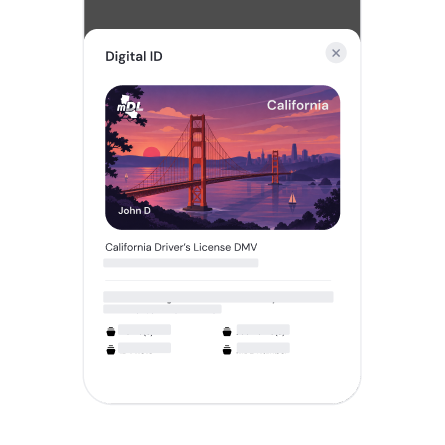
Incode has been tracking this shift closely. Recently, we participated in the California DMV's mobile driver's license showcase, part of the state's Test Credential program. Being involved early gives us critical perspective on the kinds of questions businesses are asking about mDLs.
Here is what we’ve heard so far, with honest answers.
What Is A Mobile Driver's License?
A mobile driver's license (mDL) is your state-issued ID in digital form, stored in a phone wallet. It carries the same information as a plastic card, but it is cryptographically signed by the issuing state. That signature is the important part: a verifier can confirm the credential is genuine and unaltered.
An mDL is not a photo of your license. A photo can be edited, screenshotted, or faked. An mDL proves its own authenticity through math.
Faster than plastic. Presenting an mDL takes a tap or a quick scan. No photographing the front and back of a card and waiting for it to process. For the person onboarding, a slow step becomes a fast one.
How Can Businesses Use mDLs For Verification?
The list of everyday moments is growing:
- At the airport: The Transportation Security Administration (TSA) accepts mDLs at more than 250 airport checkpoints.
- For age-restricted purchases: Buying age-gated goods in a store or proving you are over 21 online.
- Renting a car or checking into services: Confirming a valid license without handing over the physical card.
- Opening an account: Starting a new phone line or bank account, in person or online.
What Standards Do mDLs Follow?
The mDL is not a proprietary format. It is built on two international standards:
- ISO/IEC 18013-5 defines the mDL itself and how it is presented in person.
- ISO/IEC 18013-7 extends that to online and remote use: onboarding, remote age checks, account creation over the internet.
The standard defines the format of the credential: which data fields it holds, how they are encoded, and how they are signed. That is what makes an mDL verifiable no matter which wallet it came from.
The standard covers more than the data. It also defines how the credential travels: up close between a phone and a reader over short-range links like NFC and Bluetooth, and online over the internet using open web protocols. What differs between wallets is which of those methods each one implements, and the platform-specific plumbing around it. The data inside stays the same in every case: one signed set of driver's license fields.
Which U.S. States Offer mDLs?
Adoption is happening state by state. As of July 2026, 21 states plus Puerto Rico issue a standards-based mDL, according to the American Association of Motor Vehicle Administrators (AAMVA), which tracks each jurisdiction's rollout.
California has already seen widespread adoption. More than 3.5 million residents have applied for an mDL, and about 1.7 million are active today: roughly 900,000 in the state's own CA DMV Wallet and the rest across Apple Wallet, Google Wallet, and Samsung Wallet. The program launched in August 2023 and now supports four wallets.
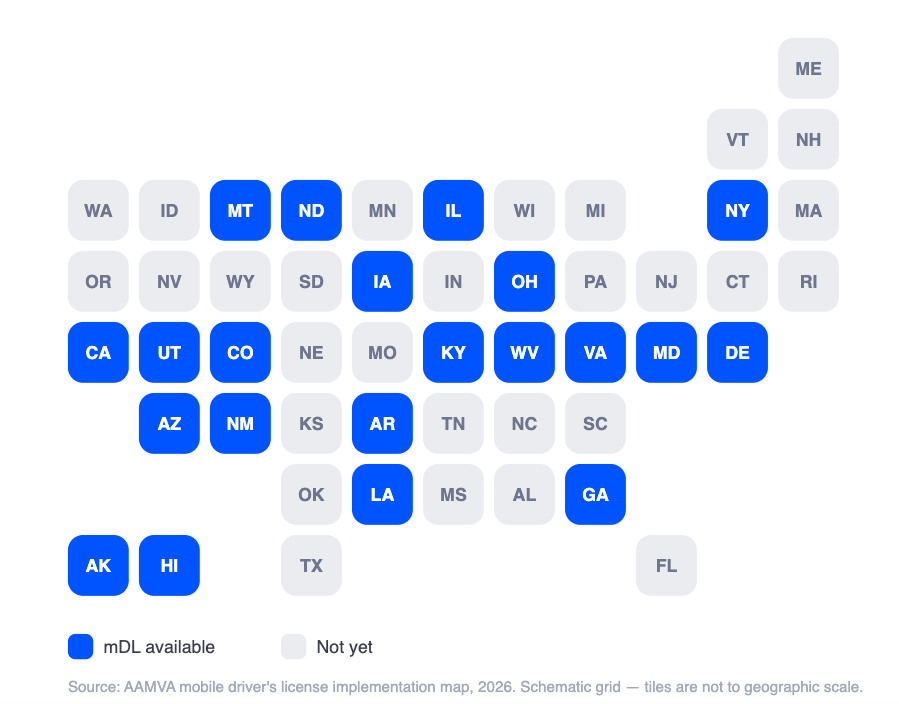
There are two kinds of wallet an mDL can live in:
- Device wallets: Also called original equipment manufacturer (OEM) wallets, device wallets are built into the phone by its maker. This includes Apple Wallet, Google Wallet, and Samsung Wallet.
- State-issued wallet apps: These wallets, including the CA DMV Wallet, are published by the DMV itself.
The takeaway for any business: no single wallet covers the whole country. Apple Wallet supports around a dozen states plus Puerto Rico, while Google Wallet supports a similar set. Coverage is a moving target, and it is fragmented across both device wallets and state apps.
Why Is an mDL Better Than the Plastic Card?
Three reasons stand out for both the person and the business:
- Selective disclosure: A person can share only what a given check needs. Proving you are over 21 can reveal a yes-or-no answer, but not your address, not your document number, and not your birth date. Less data shared means less data to protect.
- Cryptographic security: Every mDL is signed by the issuing state and bound to the device. A verifier confirms both signatures before trusting anything, so a copied or tampered credential fails the check.
- A better experience: Presenting an mDL takes seconds and works the same way every time. It presents a cleaner path than photographing a card and waiting for review.
How Does Incode Verify an mDL?
Incode verifies to the ISO 18013 standard, so support is a capability, not a fixed list of logos. We support OEM device wallets, including Apple Wallet and Google Wallet, and the CA DMV Wallet, in person and online. We are expanding to more wallets as states adopt the standard.
For the wallets that use their own presentation protocols, we implement the required cryptography end to end. For any wallet that issues a standards-compliant credential — as the CA DMV Wallet does — we verify it through our standards-based path, with no wallet-specific work. As more states adopt the standard, they fit the same path.
Whatever the source, every check validates the issuer's signature, the device's signature, and the integrity of the data before returning one unified result.
What Data Comes Back, Including License Class and Restrictions?
Because an mDL mirrors the physical license, a verifier can request the same fields the card carries, including the driving privileges: the vehicle classes a person is licensed for, the issue and expiry dates, and any restrictions or endorsements.
The credential holds this in two layers. The ISO fields report each privilege as a standardized vehicle category (A, B, C, D…) with its dates and restriction codes. The AAMVA fields carry the actual codes from the physical card: vehicle class, restrictions, and endorsements, each with a code and a description.
Some distinctions are explicit, others are not. A commercial license has a dedicated indicator. A learner's or provisional permit usually is not a single flag. Practices vary by state, so it appears inside the class structure, such as a permit class code or a permit restriction. Incode returns all of these when they are present in the credential.
Can Someone Present a Suspended or Revoked License?
If the whole credential is revoked or removed, the person cannot present it at all. If only one element is revoked, e.g. a specific driving privilege, the person can still present the credential, but a verifier that requests that element will see the permission is no longer there.
Bring mDL Verification to Your Flow
An mDL check is one step in an identity flow, not a separate product to bolt on. A completed wallet verification flows straight into your existing Incode flow, carrying the same standardized identity data your onboarding, risk, and compliance logic already read. You orchestrate it alongside your other checks: document, biometric, and risk signals.
The result is simple to build against: one integration, one result format, every compliant wallet. What you build downstream does not change as new states and wallets come online.
Incode supports OEM Wallets and the CA DMV today, ready for whichever state comes next.
Want to bring mDL verification into your identity flow? Talk to our team today.