
The Frankenstein Problem: Why Stitching Together Identity Point Solutions Is a Federal Security Risk
How many handoffs happen before you know someone is real? In many federal identity workflows, it’s more than anyone wants to admit. Document authorization comes from one vendor; liveness from another; fraud scoring from a third; biometric matching from a fourth.
Every step in this identity verification (IDV) chain provides an important security stopgap. But no one is talking about what happens between these tools. The problem isn't any single vendor—it's what happens when sensitive information and incorrect assumptions pass between them. By joining a myriad of point solutions in your IDV stack, you’re creating third-party seams that are increasingly susceptible to exploitation.
Point-Solution Handoffs Create Exploitable Seams
Every handoff between vendors creates a seam. Seams are exactly where synthetic identities and AI-generated deepfakes slip through. And they’ve become a very real issue that bad actors exploit every single second.
Picture this: someone submits a government ID. Vendor A authenticates the document and tosses the data to Vendor B for a liveness check. Vendor C runs fraud analysis. Each “handoff” is an API transformation, a queue, a manual review portal, or a shared data store, and each one is a new attack surface.
There are two main problems with this modus operandi.
First, no single vendor has an end-to-end view of the identity lifecycle. Each one sees its own slice, flags its own scores, and passes the result downstream. Nobody is watching the full chain, which means that if a synthetic identity clears step one, every step after it inherits that assumption.
Second, you have introduced a supply chain risk that most agencies never price in. When a new deepfake technique lands, one vendor might ship a fix in days. But the chain does not move until every vendor catches up, re-integrates, and re-certifies. In other words, your security posture is always defined by your slowest vendor.
Why Disconnected Stacks Fail Under Attack
Fraudsters understand how organizations approach IDV. As a result, they’re not attacking the strongest link—in this case, individual vendors—but instead, exploiting the trust that each vendor places in previous steps.
A synthetic identity that clears document authentication inherits a passing score that downstream vendors never re-examine. AI-generated deepfakes take this further: increasingly tuned to clear specific liveness checks, they arrive at fraud scoring models pre-laundered, carrying credentials those models were never trained to question.
And when something goes awry, the disconnected nature of point solutions creates even greater cracks.
Accountability Collapses
A sophisticated deepfake clears the entire stack. Document authentication? Looks clean. Liveness? No flags. Fraud scoring? Within tolerance.
Now who owns that failure? Vendor A points at Vendor B. Vendor B says the document looked legitimate. Vendor C says their model was never trained on that attack vector. Accountability does not just erode in a multi-vendor chain. It vanishes.
Responsiveness Slows to the Pace of the Slowest Vendor
Imagine that a new generative AI model drops and starts producing deepfakes that walk right past current detection. This is not hypothetical; it is happening on a near-monthly basis.
In a single-platform environment, the fix is straightforward: update the model, push the change, move on. In a multi-vendor stack? Now you are coordinating across three different release cycles, API integrations, QA processes, and contract vehicles. Weeks turn into months. The threat is not going to wait for your vendors to find time on each other’s calendars.
Speed Becomes Operational Risk
In November 2025, Secretary Hegseth issued three memorandums redesigning the Defense Acquisition System as the Warfighting Acquisition System, formally restructuring acquisition around “speed to capability.”
As a result, AI vendors must deploy the latest models within 30 days of public release. Commercial-ready technology is preferred over custom-built solutions. And acquisition delays? Formally classified as operational risk. That means a patchwork IDV stack that takes 90 days to re-certify after a vendor update isn't just a security gap. Under the new acquisition framework, it's a documented operational failure.
Zero Trust Requires Strict Governance
Identity is the first pillar of zero trust. Every digital interaction, access decision, and transaction starts with one question: is this person who they claim to be?
If the system answering that question is a Frankenstein assembly of loosely integrated tools, you have built your zero-trust architecture on top of gaps.
The Platform Approach
The alternative to point solutions is a platform approach: one system handling the identity lifecycle in a single, continuous flow—document authentication, biometric verification, liveness detection, deepfake analysis, and fraud scoring.
No handoffs. No seams between vendors. One accountability chain, so when something fails, there is a single owner. One compliance surface, so auditors are not chasing documentation across four different vendors. One integration point, so when the threat evolves tomorrow, the response also ships tomorrow.
How To Interrogate Your IDV Stack Today
If you're not sure whether your current stack has seam risk, start by asking yourself:
- How many vendors touch a single identity transaction at your agency?
- Who owns the outcome when it breaks?
- Can you audit the full verification chain end-to-end? If yes, how quickly?
Stop thinking about identity as a patchwork. Start thinking about it as a platform.
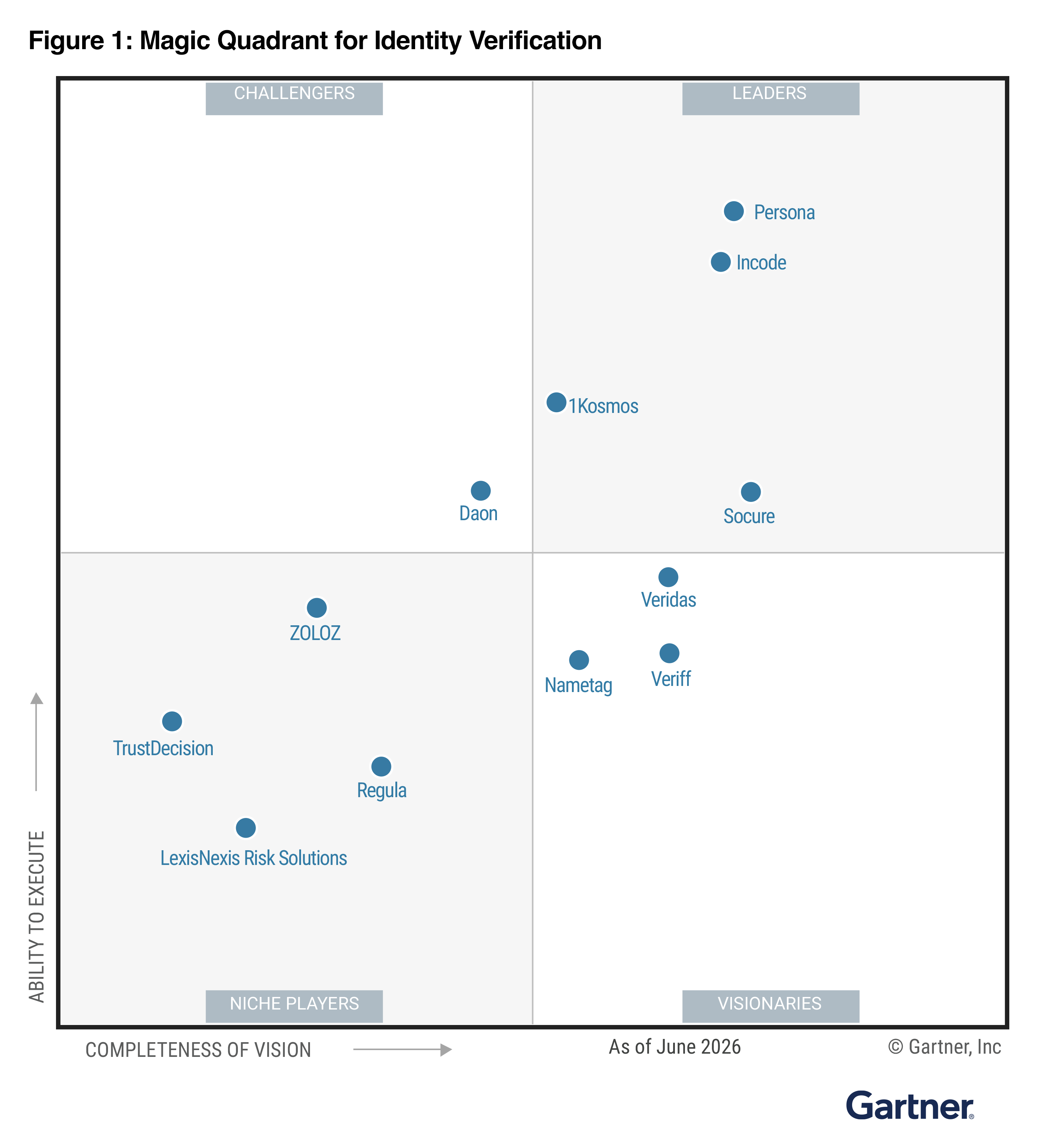
Incode was named a Leader in the 2025 Gartner® Magic Quadrant™ for Identity Verification. Download the report to learn more.