



Cyber-Fraud Fusion in Practice: The Four-Module Stack Most Vendors Are Missing
In January 2026, the World Economic Forum's Global Cybersecurity Outlook reported that cyber-enabled fraud had overtaken ransomware as executives' top security concern: 73% had been hit in the past year. The wall between cybersecurity and fraud, a divide Gartner has named cyber-fraud fusion, is finally collapsing. The term is now in every fraud leader’s deck. But the architecture behind it is minimal.
Here’s the honest truth: in 2026, most identity stacks ship just two of the four modules required by a complete fusion architecture. Those two missing modules are practically inviting attacks inside.
This piece names the four. It is not a vendor checklist; it is a description of the threat-coverage geometry that any modern stack, built or bought, should provide.
The Four Modules of Fusion Architecture
A complete cyber-fraud fusion stack catches four orthogonal attack classes, and you need one module per class. Skip a module and you lose the entire class.
1. Identity Proofing at Onboarding
This is the part of the market that most vendors have: document authenticity, face match, liveness, sanctions, and PEP screening. These checks catch the obvious bad actor at the gate. However, they do not catch a determined adversary using a deepfake-grade injection attack, a synthetic identity, or a legitimate human as a money mule.
2. Government Source-Of-Truth Validation
This is the module most stacks underweight. Verifying that a document is authentic is not the same thing as verifying that the underlying identity exists within government records and is in good standing. The gap between those two checks is exactly where most synthetic identity fraud lives.
Synthetic identities are now reported at 11% of detected fraud globally, with U.S. losses estimated at $20–35 billion per year. Deloitte projects that number will reach at least $23 billion by 2030. A document-only stack will not see them; a government-validation layer will.
3. Device and Behavioral Intelligence (Continuously Evaluated)
Without this module, you can verify who someone was at onboarding, but you cannot verify who is operating the account right now. This is the layer that catches the agentic attack, the account takeover by an AI agent, and the post-onboarding identity drift. It must operate continuously through the session, not just at login. The classical device fingerprint, designed as a stable identifier, is no longer enough on its own. Modern device intelligence is a continuous similarity signal that fuses device with behavior.
4. Cross-Account Graph Intelligence
This is the module fewest vendors ship and the one where the 2026 attacker advantage is largest. Synthetic identity farms, money-mule networks, and agentic operations all share infrastructure across many accounts: SIMs, funding rails, IPs, support-ticket linguistic patterns, and second-level transaction timing. The single-account view will never see these clusters.
A graph view across the customer base lights them up at first contact, often before the first fraudulent transaction. Industry research suggests that synthetic identities and agentic bots posing as human contributed to an 8% global rise in fraud attacks in 2025, while agentic traffic alone surged roughly 450%. The response to that attack class is cross-account graph intelligence, not better single-account scoring.
Why Most Teams Miss Several Modules
Modules two and four are the most commonly absent from real stacks. The reasons are structural.
Government source-of-truth validation is missing because it is operationally expensive to maintain. Every jurisdiction has different APIs, reliabilities, latencies, and commercial arrangements. Adding meaningful coverage means an ongoing investment in source maintenance, not a one-time integration. Vendors who do not invest in it tend to argue that document authenticity is "sufficient." But in the case of synthetic identity attacks, it is not sufficient because while the document is real, the person it describes is not.
Cross-account graph intelligence is missing because it requires data the typical scoring vendor does not have access to. To run a graph, you have to see across accounts within a customer or, where the customer's risk model allows, across an industry-wide signal. Most fraud vendors operate on a per-account scoring API and structurally cannot construct the graph. The ones that can are the ones that built the multi-tenant data architecture for it before the agentic threat made it urgent.

The result is a market where most stacks are strong on modules one and sometimes three, weaker on three than they appear, and largely silent on two and four. That is the shape of the gap as it currently stands.
Four Questions to Test Your Fraud and Identity Verification Stack
You can self-assess a stack in under fifteen minutes with four questions:
- Does our onboarding catch a 2026-quality deepfake injection attack, and how do we know? (If the answer is "we run liveness," it does not.)
- When a customer presents a valid-looking document, do we validate the underlying identity against an authoritative government source, or only the document's authenticity? (If only the latter, synthetic identity is a blind spot.)
- Once the customer is in the account, what signal updates continuously, and would we detect an agent operating the account at hour 24? (If the only post-login signal is a static device fingerprint, you are session-blind.)
- Could we tell you within a day of opening, that account number five in a synthetic-identity farm is in our customer base, given that the first four are already approved? (If not, the graph layer is missing.)
The number of "no" answers is the size of the gap. In our experience auditing customer stacks, two "no" answers is normal, three is common, and four is the failure mode that costs an institution materially in 2026. But any gap can and realistically will be exploited sooner than later.
Cyber-Fraud Fusion Is A Finished Architecture, Not A Slogan
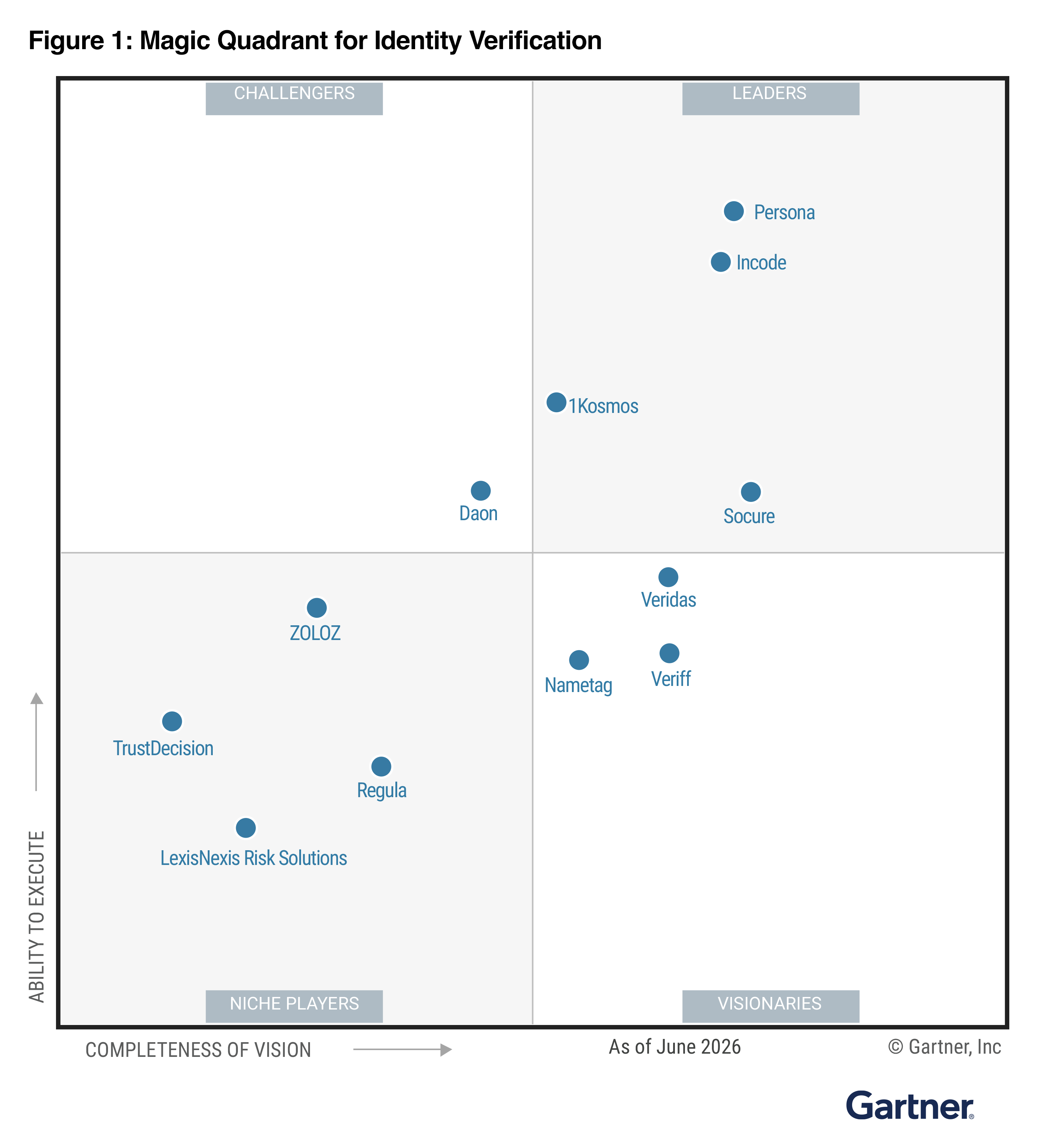
Gartner gave the term a name: cyber-fraud fusion. The architecture under it is real, and it is achievable, but only if the buyer or builder is honest about how many of the four modules are actually present and operating. The widespread reading of "fusion" as "more integrated dashboards" misses the point. Fusion is a coverage geometry across four orthogonal attack classes, and the cost of skipping a module is the entire attack class going undetected.
The defenders who will spend less on losses in 2027 are the ones building toward all four modules this year, in the order their threat exposure demands. There is no version of the modern attack mix that two modules can handle alone.
Incode's identity platform spans all four modules: document and biometric identity proofing, government source-of-truth validation, continuous device and behavioral intelligence, and cross-account graph signal. Learn more about Incode.