



Incode Acquires Identiq to Power Privacy-First Fraud Detection
Today, Incode announced the acquisition of Identiq, a pioneer in cryptographic peer-to-peer identity validation. This acquisition builds on Incode’s day-one pledge to prioritize user privacy and is just one piece of our commitment to invest $100 million toward privacy infrastructure.
Founded by security, privacy, and identity industry veterans with decades of experience in developing peer-to-peer intelligence, Identiq’s network is built on proprietary, fully anonymous identity resolution (FAIR) technology. Identiq has spent nearly a decade and more than $50 million developing its patented FAIR technology.
Together with Identiq, the Incode platform solves a problem that has plagued the identity verification (IDV) industry for decades: How can organizations collaborate to prevent fraud without inadvertently exposing customer data?
We call this the privacy-fraud paradox.
The Paradox at the Heart of Fraud Prevention
Fraudsters operate as networks. They share stolen credentials, test identities across institutions, and exploit the fact that no single organization can see the full pattern of their activity. All the while, organizations must either operate in silos or work with external IDV vendors to collect and retain sensitive customer data across a network. Recently, these shared networks have become extremely high-value targets for hackers.
The Identity Theft Resource Center found that U.S. data breaches reached an all-time high in 2025 with 3,322 reported incidents. That same year, third-party involvement in such breaches doubled from 15% to 30%.
“Every institution we spoke to asked the same question: how do we fight fraud together without giving up control of our customers' data? We built the answer to that question. With Incode, that answer is now available to every organization that needs it.”
Itay Levy, Co-Founder & CEO, Identiq
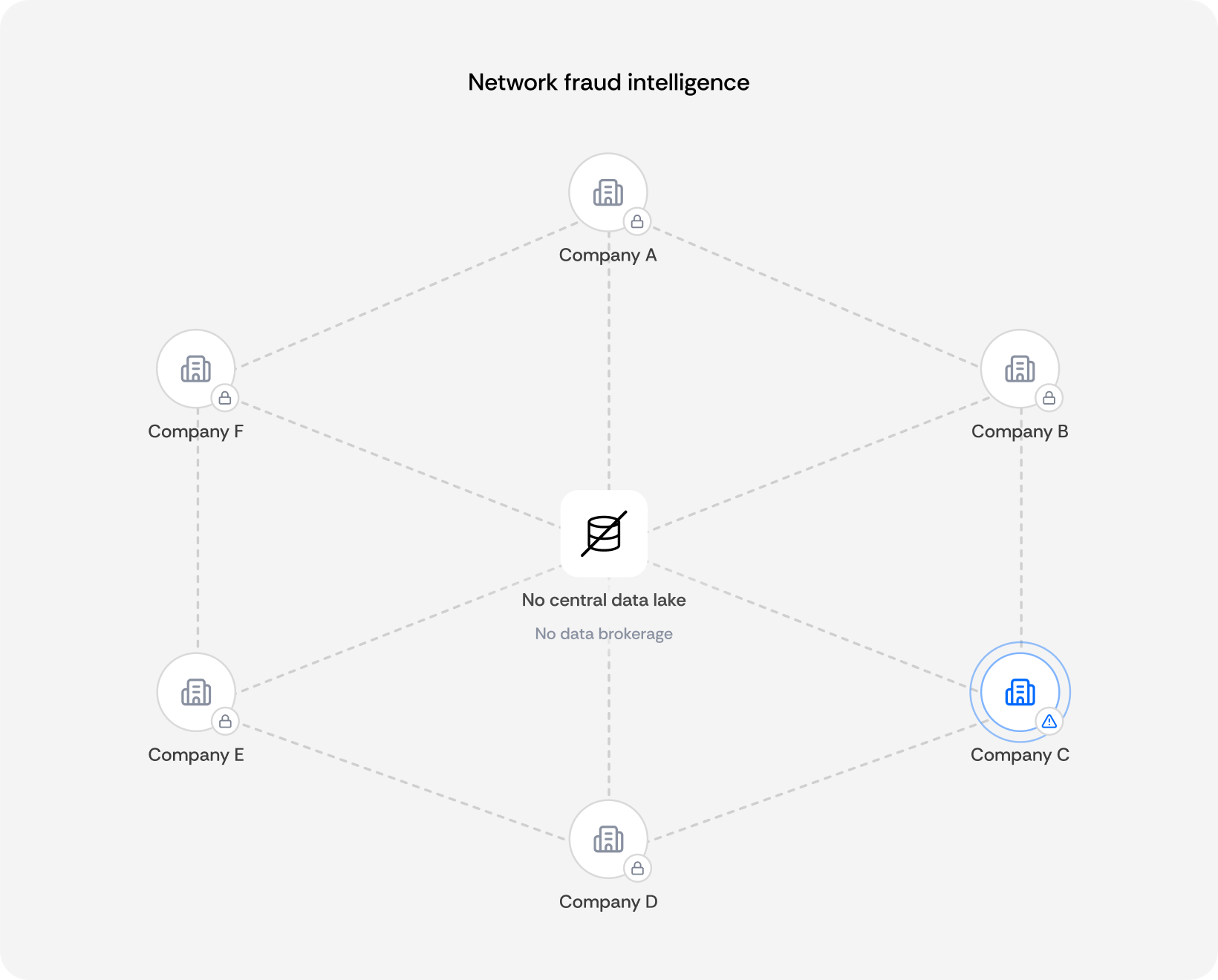
Identiq spent nearly a decade and more than $50 million developing patented cryptographic technology specifically designed to solve this problem. The result is a peer-to-peer network where institutions share fraud intelligence without any party ever gaining access to another's underlying customer data.
Identiq's Privacy Infrastructure
When a user presents identity credentials at an institution, Identiq's cryptographic layer generates a non-reversible, anonymized signal derived from that verification event. No name, document number, biometric, or raw identifier ever leaves the originating organization.
That anonymized signal is then matched against equivalent signals from other network participants using secure multi-party computation, a cryptographic technique that allows two parties to determine whether their inputs match without either party seeing the other's data.
In plain terms: Two banks can confirm they have encountered the same fraudster without either bank revealing the personally identifiable information (PII) of any one person. The fraud network becomes more accurate with every verification event, but individual data is never shared.
Why Incode and Identiq
Privacy has guided every business decision Incode has made since 2015. You’ll find evidence of our commitment to privacy throughout our architecture.
Our standard, AI-driven IDV processes don’t involve human reviewers. This decision reflects our fundamental mission to eliminate insecurities in the IDV process.
Additionally, our on-device processing capabilities are the first of their kind, enabling enterprises to verify the identity and age of their end users without sensitive data ever needing to leave the originating device. This capability is especially relevant in the context of highly regulated processes like age assurance.
For existing Identiq clients, this acquisition marks an incredible step forward. The same privacy-preserving cryptographic network they rely on is now backed by Incode's global identity infrastructure, which processes over four billion verifications annually across some of the world's most regulated industries. Two forces, now combined, create something more powerful than either could build alone.
“End-user privacy is non-negotiable. To continue protecting it, we’ve invested heavily in the absolute best privacy architecture, and that’s exactly what Identiq offered,” said Ricardo Amper, CEO & Founder at Incode. “This acquisition enables us to broaden our fraud intelligence capabilities remarkably without ever exposing a single user’s individual data.”
Identiq capabilities will become available as part of the Incode platform in the coming weeks and months.
To learn more about our commitment to privacy as architecture, visit the Incode Privacy Hub.